>
Blenniiformes (Blennies) >
Blenniidae (Combtooth blennies) > Blenniinae
Etymology: Haptogenys: Greek, hapto = to catch up + Greek, genys, -yos = face (Ref. 45335).
More on author: Day.
Taxonomic Remarks
Haptogenys quadripora Springer, 1972 is a junior synonym (Ref. 90102).
Umwelt: Milieu / Klimazone / Tiefenbereich / Verbreitungsgebiet
Ökologie
seewasser demersal. Tropical
Indo-West Pacific.
Größe / Gewicht / Alter
Geschlechtsreife: Lm ? range ? - ? cm
Max length : 7.7 cm TL Männchen/unbestimmt; (Ref. 90102)
Kurzbeschreibung
Bestimmungsschlüssel | Morphologie | Morphometrie
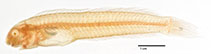
Rückenflossenstacheln (insgesamt) : 12; Rückenflossenweichstrahlen (insgesamt) : 18; Afterflossenstacheln: 2; Afterflossenweichstrahlen: 20. Live color unknown. Preserved specimen evenly pale tan with diffuse dark spot on anterior dorsal spines and another larger spot on about 10th dorsal spine. Lacking ecological information. Shortest pelvic ray < half length of longest ray; segmented caudal rays 13; lateral line tubes absent; lacking head cirri; 4 interorbital sensory pores; dorsal and anal fins unattached to caudal fin; gill opening extending ventrally to point opposite level of ventralmost pectoral-fin ray; body depth about 5.4 in SL (Ref. 90102).
Body shape (shape guide): elongated; Cross section: oval.
Oviparous. Eggs are demersal and adhesive (Ref. 205), and are attached to the substrate via a filamentous, adhesive pad or pedestal (Ref. 94114). Larvae are planktonic, often found in shallow, coastal waters (Ref. 94114).
Lebenszyklus und Paarungsverhalten
Geschlechtsreife | Fortpflanzung | Ablaichen | Eier | Fruchtbarkeit | Larven
Oviparous, distinct pairing (Ref. 205).
Randall, J.E. and K.K.P. Lim (eds.), 2000. A checklist of the fishes of the South China Sea. Raffles Bull. Zool. Suppl. (8):569-667. (Ref. 36648)
IUCN Rote Liste Status (Ref. 130435: Version 2025-2 (Global))
Bedrohung für Menschen
Harmless
Nutzung durch Menschen
Tools
Zusatzinformationen
Download XML
Internet Quellen
Schätzungen auf der Grundlage von Modellen
Phylogenetischer Diversitätsindex (Ref.
82804): PD
50 = 1.0000 [Uniqueness, from 0.5 = low to 2.0 = high].
Bayesian length-weight: a=0.00575 (0.00255 - 0.01297), b=3.06 (2.87 - 3.25), in cm total length, based on LWR estimates for this (Sub)family-body shape (Ref.
93245).
Trophische Ebene (Ref.
69278): 3.4 ±0.4 se; based on size and trophs of closest relatives
Widerstandsfähigkeit (Ref.
120179): hoch, Verdopplung der Population dauert weniger als 15 Monate. (Preliminary K or Fecundity.).
Anfälligkeit der Fischerei (Ref.
59153): Low vulnerability (10 of 100).
🛈