Classification / Noms
Noms communs | Synonymes | Catalog of Fishes(Genre, Espèce) | ITIS | CoL | WoRMS | Cloffa
>
Blenniiformes (Blennies) >
Blenniidae (Combtooth blennies) > Salariinae
Etymology: Dodekablennos: Greek, dodeka = twelve + Greek, blennos = mucus (Ref. 45335); also, meaning "blenny"; in reference to the 12 dorsal-fin spines and pectoral-fin rays (Ref. 69212).
Eponymy: Dr Thomas Henry Fraser is an ichthyologist specialising in cardinalfish, who works at Florida Museum of Natural History, University of Florida, Gainesville and at Mote Marine Laboratory, Sarasota, Florida. [...] (Ref. 128868), visit book page.
Environnement : milieu / zone climatique / profondeur / gamme de distribution
Écologie
marin démersal; profondeur 0 - 2 m (Ref. 33390). Tropical
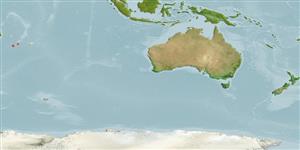
Western Indian Ocean: Reunion and Mauritius.
Taille / Poids / Âge
Maturité: Lm ? range ? - ? cm
Max length : 3.7 cm SL mâle / non sexé; (Ref. 69212)
Description synthétique
Clés d'identification | Morphologie | Morphométrie
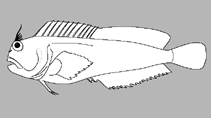
Épines dorsales (Total) : 12; Rayons mous dorsaux (Total) : 19 - 20; Épines anales: 2; Rayons mous anaux: 21. With 12 pectoral-fin rays; with no nape and orbital cirri; typically with fewer than 65 teeth in each jaw; with vomerine teeth; 12 dorsal-fin spines and with only 2-6 branched caudal-fin rays; terminal anal-fin ray unbound by membrane to the caudal peduncle. Males possessing a fleshy, blade-like crest on head. Color pattern based on preserved specimens: dusky head, ventrally paler with slightly dusky chevron in smaller specimens or a cross mark on the largest specimen; dusky bar continuing ventrally beginning from midventral margin of orbit across lip, posteriorly alternated by paler area from diffuse dusky bar continuing ventrally from just posterior to eye across corner of mouth to ventral surface of head, contributing to formation of dusky chevron; pale upper lip and male crest with dusky spots; lateral side of body with 7-8 dark dusky bands interspersed with pale areas; anteriormost band dorsally diffused; all bands continuing onto dorsal fin; posterior bands typically dorsally forked in males and both dorsally and ventrally in females; posteriormost band expanded in largest specimen, continuing ventroposteriorly well onto caudal fin and joining dusky stripe along ventral margin of fin; dorsal-fin spines and rays variably dusky; males with distal intensely black spots on each of the first three interradial membranes; female lacking black spots; anal fin dusky and submarginally darker; spine and ray tips without pigmentation (Ref. 69212).
Found in tide pools (Ref. 33390). Oviparous. Eggs are demersal and adhesive (Ref. 205), and are attached to the substrate via a filamentous, adhesive pad or pedestal (Ref. 94114). Larvae are planktonic, often found in shallow, coastal waters (Ref. 94114).
Cycle de vie et comportement reproducteur
Maturité | Reproduction | Frai | Œufs | Fécondité | Larves
Oviparous, distinct pairing (Ref. 205).
Fricke, R., 1999. Fishes of the Mascarene Islands (Réunion, Mauritius, Rodriguez): an annotated checklist, with descriptions of new species. Koeltz Scientific Books, Koenigstein, Theses Zoologicae, Vol. 31:759 p. (Ref. 33390)
Statut dans la liste rouge de l'IUCN (Ref. 130435: Version 2025-2 (Global))
Menace pour l'homme
Harmless
Utilisations par l'homme
Outils
Articles particuliers
Télécharger en XML
Sources Internet
Estimations basées sur des modèles
Température préférée (Réf.
123201): 25.4 - 27.5, mean 25.6 °C (based on 9 cells).
Indice de diversité phylogénétique (Réf.
82804): PD
50 = 1.0000 [Uniqueness, from 0.5 = low to 2.0 = high].
Bayesian length-weight: a=0.00776 (0.00354 - 0.01702), b=3.00 (2.81 - 3.19), in cm total length, based on LWR estimates for this (Sub)family-body shape (Ref.
93245).
Résilience (Réf.
120179): Haut, temps minimum de doublement de population inférieur à 15 mois (Preliminary K or Fecundity.).
Vulnérabilité de la pêche (Ref.
59153): Low vulnerability (10 of 100).
🛈