Classification / Noms
Noms communs | Synonymes | Catalog of Fishes(Genre, Espèce) | ITIS | CoL | WoRMS | Cloffa
>
Eupercaria/misc (Various families in series Eupercaria) >
Labridae (Wrasses) > Cirrhilabrinae
Etymology: Paracheilinus: Greek, para = the side of + Greek, chaite = hair + Greek, odous = teeth (Ref. 45335); attenuatus: From the Latin attenuatus meaning drawn out or tapering, in reference to the shape of the caudal fin.
More on author: Randall.
Environnement : milieu / zone climatique / profondeur / gamme de distribution
Écologie
marin démersal; profondeur 21 - 50 m (Ref. 41634). Tropical
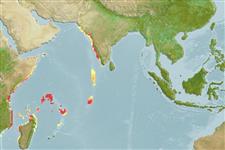
Western Indian Ocean: known only from one atoll of the Amirante Islands in Seychelles and one specimen from the aquarium trade from Kenya.
Taille / Poids / Âge
Maturité: Lm ? range ? - ? cm
Max length : 6.0 cm SL mâle / non sexé; (Ref. 41634)
Description synthétique
Clés d'identification | Morphologie | Morphométrie
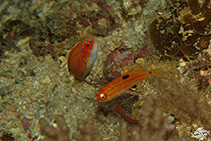
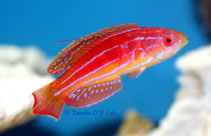
Épines dorsales (Total) : 9; Rayons mous dorsaux (Total) : 11; Épines anales: 3; Rayons mous anaux: 9; Vertèbres: 25. Median predorsal scales 5; horizontal scale rows on cheek below eye 2; body depth 3.2-3.55 in SL; ; head length 2.9-3.05 in SL; snout length 3.9-4.1 in HL; first dorsal soft ray of adults long and filamentous; caudal fin rounded in young, lanceolate with strongly concave upper and lower posterior margin in adults, the fin length 2.9-3.6 in SL; pelvic fin short, 1.6-1.8 in HL. Adult males in life light orange, shading to yellow ventrally, with four longitudinal lavender bands on body which link to three narrow lavender bands extending posteriorly from eye; dorsal fin yellow with a broad blue-edged red zone posteriorly in fin, the filament red. Small females with the same but narrower stripes, dark-edged blue lines dorsally on head, a large dark brown spot at base of dorsal fin below juncture of spinous and soft portions, and a small dark brown spot dorsoposteriorly on caudal peduncle.
Body shape (shape guide): fusiform / normal.
Found over rubble or hard bottom (Ref. 41634). Largest size recorded is 6.58 mm SL from the aquarium trade (Ref. 41634).
Cycle de vie et comportement reproducteur
Maturité | Reproduction | Frai | Œufs | Fécondité | Larves
Oviparous, distinct pairing during breeding (Ref. 205).
Randall, J.E., 1999. Paracheilinus attenuatus, a new labrid fish from the western Indian Ocean, with a redescription of P. piscilineatus . J. South Asian Nat. Hist. 4(1):29-38. (Ref. 41634)
Statut dans la liste rouge de l'IUCN (Ref. 130435: Version 2025-2 (Global))
Menace pour l'homme
Harmless
Utilisations par l'homme
Pêcheries: commercial; Aquarium: Commercial
Outils
Articles particuliers
Télécharger en XML
Sources Internet
Estimations basées sur des modèles
Température préférée (Réf.
123201): 26 - 27, mean 26.7 °C (based on 6 cells).
Indice de diversité phylogénétique (Réf.
82804): PD
50 = 0.5000 [Uniqueness, from 0.5 = low to 2.0 = high].
Bayesian length-weight: a=0.01072 (0.00427 - 0.02691), b=3.03 (2.81 - 3.25), in cm total length, based on LWR estimates for this (Sub)family-body shape (Ref.
93245).
Niveau trophique (Réf.
69278): 3.4 ±0.4 se; based on size and trophs of closest relatives
Résilience (Réf.
120179): Haut, temps minimum de doublement de population inférieur à 15 mois (Preliminary K or Fecundity.).
Vulnérabilité de la pêche (Ref.
59153): Low vulnerability (10 of 100).
🛈