>
Eupercaria/misc (Various families in series Eupercaria) >
Labridae (Wrasses) > Cirrhilabrinae
Etymology: Cirrhilabrus: Latin, cirrus = curl fringe + Greek, labros = furious (Ref. 45335); earlei: Named in honor of John L. Earle who collected the holotype.
Eponymy: John L Earle is a founder member of the Association for Marine Exploration. [...] (Ref. 128868), visit book page.
More on authors: Randall & Pyle.
Entorno: milieu / zona climática / rango de profundidad / gama de distribución
Ecología
marino asociado a arrecife; rango de profundidad 60 - 110 m (Ref. 41654). Tropical
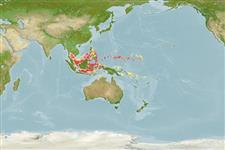
Western Central Pacific: Palau and Micronesia.
Longitud en la primera madurez / Tamaño / Peso / Edad
Madurez: Lm ?, range 5 - ? cm
Max length : 6.9 cm SL macho / no sexado; (Ref. 41654)
Descripción breve
Claves de identificación | Morfología | Morfometría
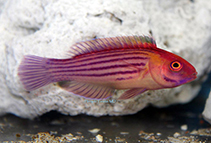
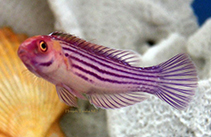
Espinas dorsales (total) : 11; Radios blandos dorsales (total) : 9; Espinas anales: 3; Radios blandos anales: 9; Vértebra: 25. This species is distinguished by the following characters: D XI,9; A III,9; pectoral fin rays 15; dorsal fin with progressively longer spine where the 11th is 2.4-2.6 in head; in males the interspinous membranes do not extend above the spine tips; pelvic fins of male short 4.05-4.9 in SL; rounded to rhomboid caudal fin; lateral line scales 16-17 + 5-6; median predorsal scales 4-5; cheeks with 2 horizontal rows of scales; colour in life pale red, shading to pale yellow on abdomen, with deep red longitudinal lines on body following scale rows (persists as lavender to purple when preserved); head with two deep pink bands, one from upper lip passing over eye to origin of dorsal fin, the other from lower lip along mandible to corner or preopercle; operculum yellow; dorsal fin yellow anteriorly with a black spot on first membrane, spines red; rest of fin and caudal fin light red with deep red rays; pelvic fins yellow with red spines and rays (Ref. 41654).
Body shape (shape guide): fusiform / normal; Cross section: compressed.
Inhabits mixed coral, rubble, and sand slopes along the bases of steep protected seaward reefs (Ref. 37816). Maximum depth reported taken from Ref. 128797.
Ciclo vital y comportamiento de apareamiento
Madurez | Reproducción | Puesta | Huevos | Fecundidad | Larva
Distinct pairing during breeding (Ref. 205).
Randall, J.E. and R.L. Pyle, 2001. Three new species of labrid fishes of the genus Cirrhilabrus from islands of the tropical Pacific. aqua, J. Ichthyol. Aquat. Biol. 4(3):89-98. (Ref. 41654)
Situación en la Lista Roja de la UICN (Ref. 130435: Version 2025-2 (Global))
Amenaza para el ser humano
Harmless
Usos humanos
Herramientas
Informes especiales
Descargar XML
Fuentes de Internet
Estimaciones basadas en modelos
Temperatura preferida (Referencia
123201): 12.6 - 28.5, mean 23 °C (based on 8 cells).
Índice de diversidad filogenética (Referencia
82804): PD
50 = 0.5000 [Uniqueness, from 0.5 = low to 2.0 = high].
Bayesian length-weight: a=0.01072 (0.00427 - 0.02691), b=3.03 (2.81 - 3.25), in cm total length, based on LWR estimates for this (Sub)family-body shape (Ref.
93245).
Nivel trófico (Referencia
69278): 3.3 ±0.4 se; based on size and trophs of closest relatives
Resiliencia (Referencia
120179): Alto, población duplicada en un tiempo mínimo inferior a 15 meses (Preliminary K or Fecundity.).
Vulnerabilidad pesquera (Ref.
59153): Low vulnerability (10 of 100).
🛈