>
Perciformes/Cottoidei (Sculpins) >
Cottidae (Sculpins)
Etymology: Andriashevicottus: Because of Anatoly Petrovich Andriashev, Russian naturalist, 1910 + Greek, kottos = a fish without identificaction; megacephalus: From the Greek megas meaning large, and the Greek cephale meaning head, in reference to its large head.
Eponymy: Professor Dr Anatoly Petrovich Andriyashev (1910–2009) was a Russian marine biologist. [...] (Ref. 128868), visit book page.
Environnement : milieu / zone climatique / profondeur / gamme de distribution
Écologie
marin démersal; profondeur 100 - ? m (Ref. 41742). Boreal
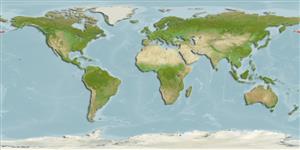
Northwest Pacific: known only from the holotype taken from off Simushir Island, Kuril Islands.
Taille / Poids / Âge
Maturité: Lm ? range ? - ? cm
Max length : 23.6 cm TL mâle / non sexé; (Ref. 41742)
Description synthétique
Clés d'identification | Morphologie | Morphométrie
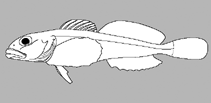
Épines dorsales (Total) : 9; Rayons mous dorsaux (Total) : 20; Rayons mous anaux: 13; Vertèbres: 40. Head large; subopercle spines 4, upper one is largest, bent upward, forked; no spines and crests on occiput; scales on the head in dorsal view stretch forward along the interorbital space to the anterior margin of the eye; in lateral view, scales drop to the level of the lower posterior margin of the eye, the suborbital support and upper preopercular spine; body scales below the base of dorsal spine in the form of a band with irregular diagonal rows, in a row along the lateral line and in a spot under the pectoral fin behind the upper margin of its base. 2 nostrils; branchiostegal membranes united and free of isthmus; well developed pseudobranch; a small opening behind the 4th gill arch (Ref. 41742).
Minimum depth from Ref. 58018.
Cycle de vie et comportement reproducteur
Maturité | Reproduction | Frai | Œufs | Fécondité | Larves
Fedorov, V.V., 1990. Andriashevicottus megacephalus gen. et sp. n. (Cottidae) from the coastal waters of the Kuril Islands. J. Ichthyol. 30(6):122-131. (Ref. 41742)
Statut dans la liste rouge de l'IUCN (Ref. 130435: Version 2025-2 (Global))
Menace pour l'homme
Harmless
Utilisations par l'homme
Outils
Articles particuliers
Télécharger en XML
Sources Internet
Estimations basées sur des modèles
Température préférée (Réf.
123201): 0.8 - 3.6, mean 1.2 °C (based on 6 cells).
Indice de diversité phylogénétique (Réf.
82804): PD
50 = 1.0000 [Uniqueness, from 0.5 = low to 2.0 = high].
Bayesian length-weight: a=0.00603 (0.00290 - 0.01252), b=3.14 (2.96 - 3.32), in cm total length, based on LWR estimates for this (Sub)family-body shape (Ref.
93245).
Niveau trophique (Réf.
69278): 3.5 ±0.5 se; based on size and trophs of closest relatives
Résilience (Réf.
120179): Faible, temps minimum de doublement de population : 4,5 à 14 années (Preliminary K or Fecundity.).
Vulnérabilité de la pêche (Ref.
59153): Low vulnerability (14 of 100).
🛈