>
Acanthuriformes (Surgeonfishes) >
Zanclidae (Moorish idol)
Etymology: Zanclus: Greek, za = an augmentative particle + Greek, agklino = to be on one´s back (Ref. 45335).
More on author: Linnaeus.
Meio ambiente: milieu / Zona climática / intervalo de profundidade / faixa de distribuição
Ecologia
marinhas associadas(os) a recifes; intervalo de profundidade 0 - 182 m (Ref. 9710), usually 5 - 182 m (Ref. 27115). Subtropical; 24°C - 28°C (Ref. 27115); 32°N - 37°S, 21°E - 70°W
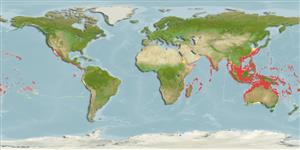
Indo-Pacific: East Africa to Rapa and Ducie islands, north to southern Japan and the Hawaiian Islands, south to the Lord Howe Island. Eastern Pacific: southern Gulf of California to Peru (Ref. 9267).
Tamanho / Peso / Idade
Maturidade: Lm ? range ? - ? cm
Max length : 23.0 cm TL macho/indeterminado; (Ref. 6113); common length : 21.0 cm NG macho/indeterminado; (Ref. 5755)
Descrição suscinta
Chaves de identificação | Morfologia | Morfometria
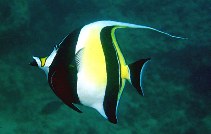
Espinhos dorsais (total) : 6 - 7; Raios dorsais (total) : 39 - 43; Espinhos anais: 3; Raios anais : 31 - 37. Strongly compressed discoid body. Tubular snout with a small mouth containing numerous elongate bristle-like teeth. Dorsal spines elongated into a whip-like filament.
Body shape (shape guide): short and / or deep; Cross section: compressed.
Adults inhabit turbid inner lagoons, reef flats, and clear seaward rocky and coral reefs (Ref. 1602, 48637). Benthopelagic (Ref. 58302). Generally encountered in small groups of 2 or 3 individuals (Ref. 9267). Adults occur singly, in pairs and occasionally are seen in large schools (Ref. 48637). They feed on small encrusting animals (Ref. 6113). Size of metamorphosis from postlarva to juvenile is 7.5 cm (Ref. 9267). The long pelagic larval stage is the reason for the wide distribution and strong colouration that shows no geographical variation (Ref. 48637). Popular aquarium fish but rarely survives in tanks (Ref. 1602). Minimum depth reported taken from Ref. 128797.
Ciclo de vida ou comportamento de acasalamento
Maturidade | Reprodução | Desova | Ovos | Fecundidade | Larvas
Myers, R.F., 1991. Micronesian reef fishes. Second Ed. Coral Graphics, Barrigada, Guam. 298 p. (Ref. 1602)
Status na Lista Vermelha da UICN (Ref. 130435: Version 2025-2 (Global))
Ameaça para os humanos
Harmless
Uso pelos humanos
Pescarias: pesca de subsistência; Aquário: Espécies comerciais
Ferramentas
Relatórios especiais
Baixar XML
Fontes da internet
Estimativas baseadas em modelos
Temperatura preferida (Ref.
123201): 20 - 29, mean 27.7 °C (based on 4016 cells).
Índice de diversidade filogenética (Ref.
82804): PD
50 = 1.5000 [Uniqueness, from 0.5 = low to 2.0 = high].
Bayesian length-weight: a=0.01738 (0.00674 - 0.04483), b=3.06 (2.84 - 3.28), in cm total length, based on LWR estimates for this (Sub)family-body shape (Ref.
93245).
Nível Trófico (Ref.
69278): 2.5 ±0.00 se; based on food items.
Vulnerabilidade da pesca (Ref.
59153): Low vulnerability (13 of 100).
🛈
Nutrientes (Ref.
124155): Calcium = 44.8 [19.5, 73.0] mg/100g; Iron = 0.697 [0.404, 1.262] mg/100g; Protein = 18.8 [17.5, 20.0] %; Omega3 = 0.175 [0.095, 0.315] g/100g; Selenium = 22.8 [10.2, 47.4] μg/100g; VitaminA = 29.5 [6.8, 126.5] μg/100g; Zinc = 1.05 [0.66, 1.62] mg/100g (wet weight);