Classification / Noms
Noms communs | Synonymes | Catalog of Fishes(Genre, Espèce) | ITIS | CoL | WoRMS | Cloffa
>
Cyprinodontiformes (Rivulines, killifishes and live bearers) >
Poeciliidae (Poeciliids) > Poeciliinae
Etymology: Brachyrhaphis: Greek, brachys, eia = short + Greek, raphis = needle (Ref. 45335).
More on author: Meek.
Environnement : milieu / zone climatique / profondeur / gamme de distribution
Écologie
; eau douce pélagique; non migrateur. Tropical; 19°C - 34°C (Ref. 36880)
Central America: Costa Rica.
Taille / Poids / Âge
Maturité: Lm ? range ? - ? cm
Max length : 6.0 cm SL mâle / non sexé; (Ref. 36880); 3.4 cm SL (female)
Description synthétique
Clés d'identification | Morphologie | Morphométrie
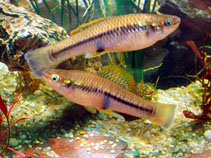
The 10 dark bars on the sides of the body are more pronounced in males. The population in the headwaters of Río Virilla near Santa Ana and Villa Colón are larger and most individuals lack the vertical bars. Interradial membranes on the base of the dorsal fin and the rays are jet black; distal half of the fin yellowish or orange and the margin is black in both sexes. Anal fin is yellow or yellow-orange and has a black blotch from the base to the tip of the fin. Pelvic fins yellowish and caudal distal margin often brilliant yellow (Ref. 36880).
Body shape (shape guide): elongated; Cross section: oval.
An insectivorous fish generally inhabits waters of low to moderate current velocity; between 10 and 900 m elevation; at temperatures of 19 to 34°C; in surface or midwaters of brooks, streams. Occasionally found in shallow waters of rivers (Ref. 36880).
Cycle de vie et comportement reproducteur
Maturité | Reproduction | Frai | Œufs | Fécondité | Larves
Bussing, W.A., 1998. Peces de las aguas continentales de Costa Rica [Freshwater fishes of Costa Rica]. 2nd Ed. San José Costa Rica: Editorial de la Universidad de Costa Rica. 468 p. (Ref. 36880)
Statut dans la liste rouge de l'IUCN (Ref. 130435: Version 2025-2 (Global))
Menace pour l'homme
Harmless
Utilisations par l'homme
Outils
Articles particuliers
Télécharger en XML
Sources Internet
Estimations basées sur des modèles
Indice de diversité phylogénétique (Réf.
82804): PD
50 = 0.5002 [Uniqueness, from 0.5 = low to 2.0 = high].
Bayesian length-weight: a=0.00851 (0.00369 - 0.01962), b=3.15 (2.96 - 3.34), in cm total length, based on LWR estimates for this (Sub)family-body shape (Ref.
93245).
Niveau trophique (Réf.
69278): 3.2 ±0.40 se; based on food items.
Résilience (Réf.
120179): Haut, temps minimum de doublement de population inférieur à 15 mois (Preliminary K or Fecundity.).
Vulnérabilité de la pêche (Ref.
59153): Low vulnerability (10 of 100).
🛈