Élasmobranches (requins et raies) (sharks and rays) >
Carcharhiniformes (Ground sharks) >
Triakidae (Houndsharks) > Triakinae
Etymology: Scylliogaleus: Etymology not explained, presumably a combination of Scyllium and galeus, i.e., a “galeid” shark with “nostrils as in Scyllium” (=Scyliorhinus, Scyliorhinidae) (See ETYFish); quecketti: In honor of London-born conchologist John Frederick Whitlie Quekett (1849-1913), Curator, Durban Museum (South Africa), who provided holotype [Boulenger consistently misspelled Quekett’s name as “Queckett”] (See ETYFish).
Eponymy: John Frederick Whitlie Quekett (1849–1913) was born in London, but emigrated to Natal (1871) and was appointed to organise the collection of the Natal Society (1886). [...] (Ref. 128868), visit book page.
More on author: Boulenger.
Environnement : milieu / zone climatique / profondeur / gamme de distribution
Écologie
marin démersal. Subtropical; 27°S - 33°S
Western Indian Ocean: Natal and northeastern Cape in South Africa.
Taille / Poids / Âge
Maturité: Lm ? range ? - ? cm
Max length : 89.0 cm TL mâle / non sexé; (Ref. 244); 102.0 cm TL (female)
Description synthétique
Clés d'identification | Morphologie | Morphométrie
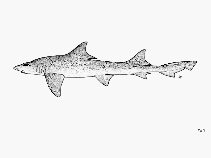
Épines dorsales (Total) : 0; Épines anales: 0. A blunt-nosed houndshark with large, fused nasal flaps, and small, blunt, pebble-like teeth; 2nd dorsal fin as large as 1st (Ref. 5578). Grey above, cream below; newborn with white rear edges on dorsal, anal and caudal fins (Ref. 5578).
Body shape (shape guide): elongated.
Occurs from the surf line to close offshore (Ref. 5578). Feeds mainly on crustaceans (including lobsters), also squid (Ref. 244). Viviparous (Ref. 50449). Caught by rock and surf anglers (Ref. 5578).
Cycle de vie et comportement reproducteur
Maturité | Reproduction | Frai | Œufs | Fécondité | Larves
Viviparous, placental (Ref. 50449). With 2 to 4 young in a litter (Ref. 244, 5578). Size at birth about 34 cm (Ref. 244). Gestation period is 9 to 10 months (Ref. 244). Distinct pairing with embrace (Ref. 205).
Compagno, L.J.V., 1984. FAO Species Catalogue. Vol. 4. Sharks of the world. An annotated and illustrated catalogue of shark species known to date. Part 2 - Carcharhiniformes. FAO Fish. Synop. 125(4/2):251-655. Rome: FAO. (Ref. 244)
Statut dans la liste rouge de l'IUCN (Ref. 130435: Version 2025-2 (Global))
Menace pour l'homme
Harmless
Utilisations par l'homme
Pêcheries: pêcheries vivrières; pêche sportive: oui
Outils
Articles particuliers
Télécharger en XML
Sources Internet
Estimations basées sur des modèles
Indice de diversité phylogénétique (Réf.
82804): PD
50 = 1.0000 [Uniqueness, from 0.5 = low to 2.0 = high].
Bayesian length-weight: a=0.00245 (0.00117 - 0.00517), b=3.14 (2.96 - 3.32), in cm total length, based on LWR estimates for this (Sub)family-body shape (Ref.
93245).
Niveau trophique (Réf.
69278): 3.6 ±0.5 se; based on diet studies.
Résilience (Réf.
120179): Très faible, temps minimum de doublement de population supérieur à 14 ans (Fec=2).
Vulnérabilité de la pêche (Ref.
59153): High vulnerability (61 of 100).
🛈