>
Perciformes/Bembropoidei (Duckbill flatheads) >
Bembropidae (Duckbill flatheads)
Etymology: Bembrops: Greek, bembras, -ados = a kind of anchovy m+ Greek, ops = appearance (Ref. 45335); raneyi: Named after the late Dr. Edward C. Raney, former Professor of Ichthyology at Cornell University.
Eponymy: Dr Edward Cowden Raney (1909–1984) was an American ichthyologist who was Professor of Zoology at Cornell University (1952–1971). [...] (Ref. 128868), visit book page.
Ambiente: milieu / zona climatica / distribuzione batimetrica / gamma di distribuzione
Ecologia
marino batidemersale; distribuzione batimetrica 284 - 759 m (Ref. 31109), usually 500 - 759 m (Ref. 31109). Deep-water
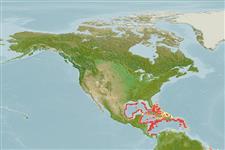
Western Central Atlantic: Bahamas.
Dimensione / Peso / Età
Maturità: Lm ? range ? - ? cm
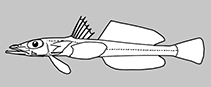
Max length : 17.6 cm SL maschio/sesso non determinato; (Ref. 31109)
Ciclo vitale e comportamento di accoppiamento
Maturità | Riproduzione | Deposizione | Uova | Fecondità | Larve
Thompson, B.A. and R.D. Suttkus, 1998. A review of western north Atlantic species of Bembrops, with descriptions of three new species, and additional comments on two eastern Atlantic species (Pisces: Percophidae). Proc. Biol. Soc. Wash. 111(4):954-985. (Ref. 31109)
Stato della Lista Rossa IUCN (Ref. 130435: Version 2025-2 (Global))
Minaccia per l'uomo
Harmless
Usi umani
Strumenti
Rapporti speciali
Scarica XML
Fonti Internet
Stime basate su modelli
Temperatura preferita (Fonte Biblio.
123201): 6.1 - 13.7, mean 8.8 °C (based on 97 cells).
Indice di diversità filogenetica (Fonte Biblio.
82804): PD
50 = 0.5000 [Uniqueness, from 0.5 = low to 2.0 = high].
Bayesian length-weight: a=0.00380 (0.00158 - 0.00917), b=3.11 (2.90 - 3.32), in cm total length, based on LWR estimates for this (Sub)family-body shape (Ref.
93245).
Livello trofico (Fonte Biblio.
69278): 4.0 ±0.4 se; based on size and trophs of closest relatives
Vulnerabilità della pesca (Ref.
59153): Low vulnerability (11 of 100).
🛈