>
Acropomatiformes (Oceanic basses) >
Hemerocoetidae (Indo-Pacific duckbills)
Etymology: Squamicreedia: Latin, squama = scale + Greek, kreesi, kreas = somebody that receives or keeps flesh (Ref. 45335).
Milieu: milieu / Klimaatzone / Diepte / verspreidingsgebied
Ecologie
marien demersaal. Tropical
Indo-West Pacific: known only from northern Australia.
Grootte / Gewicht / Leeftijd
Maturiteit: Lm ? range ? - ? cm
Max length : 8.0 cm TL mannelijk / geslacht onbekend; (Ref. 36661)
Dorsale stekels (totaal) : 2 - 6; Dorsale zachte stralen (totaal) : 13 - 23; Anale zachte stralen: 15 - 29. Anterior nostril with single projection (Ref 12392).
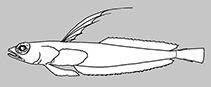
Body shape (shape guide): elongated.
Found on sand bottoms.
Levenscyclus en paargedrag
Maturiteit | Voortplanting | Paaien | Eieren | Fecunditeit | Larven
Allen, G.R., 1997. The marine fishes of tropical Australia and south-east Asia. Western Australian Museum, Perth, Western Australia. 292 p. (Ref. 36661)
Status op de Rode Lijst van het IUCN (Ref. 130435: Version 2025-2 (Global))
Gevaar voor de mens
Harmless
Gebruik door de mens
Tools
Speciale rapporten
Download XML
Internetbronnen
Schattingen op basis van modellen
Fylogenetische diversiteitsindex (Ref.
82804): PD
50 = 1.0000 [Uniqueness, from 0.5 = low to 2.0 = high].
Bayesian length-weight: a=0.00389 (0.00180 - 0.00842), b=3.12 (2.94 - 3.30), in cm total length, based on all LWR estimates for this body shape (Ref.
93245).
Trofisch niveau (Ref.
69278): 3.3 ±0.4 se; based on size and trophs of closest relatives
Weerstandsvermogen (Ref.
120179): Hoog, minimale populatieverdubbelingstijd minder dan 15 maanden (Preliminary K or Fecundity.).
Kwetsbaarheid van de visserij (Ref.
59153): Low vulnerability (10 of 100).
🛈
Voedingsstoffen (Ref.
124155): Calcium = 354 [198, 800] mg/100g; Iron = 1.63 [0.96, 2.94] mg/100g; Protein = 17.4 [16.4, 18.5] %; Omega3 = 0.231 [0.115, 0.468] g/100g; Selenium = 57.8 [23.9, 138.3] μg/100g; VitaminA = 65.6 [21.3, 200.7] μg/100g; Zinc = 1.61 [1.06, 2.41] mg/100g (wet weight);