Milieu: milieu / Klimaatzone / Diepte / verspreidingsgebied
Ecologie
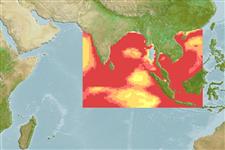
marien; brak water pelagic-oceanic; oceanodroom (Ref. 51243); diepte 0 - 50 m (Ref. 189). Tropical; 25°N - 9°S, 69°E - 117°E (Ref. 189)
Indo-West Pacific: western coast of India to Myanmar and south to Java, Indonesia.
Lengte bij maturiteit / Grootte / Gewicht / Leeftijd
Maturiteit: Lm 13.0 range ? - ? cm
Max length : 19.0 cm TL mannelijk / geslacht onbekend; (Ref. 55634); 20.5 cm TL (female); max. gepubliceerd gewicht: 60.70 g (Ref. 55634); max. gepubliceerd gewicht: 60.70 g
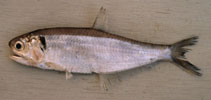
Dorsale stekels (totaal) : 0; Anale stekels: 0; Anale zachte stralen: 29 - 37. Belly with 24 to 32 keeled scutes from isthmus to anus. Tip of snout on a level with eye center. Maxilla long, reaching to or almost to base of first pectoral fin ray; first supra-maxilla oval, minute. Lower gill rakers with serrae on the inner edge even and not clumped. A dark blotch behind upper part of gill opening.
Body shape (shape guide): fusiform / normal; Cross section: compressed.
Found in coastal pelagic waters and often observed as entering mangroves and adjacent brackish waters (Ref. 43081). Juveniles and adults may penetrate the upper reaches where mixohaline-mesohaline conditions prevail. Eggs and larvae are found in the lower reaches of the mangroves (Ref. 43081). A schooling species found mostly inshore. Feed on planktonic organisms in coastal waters (Ref. 43081). Juveniles in mangroves feed on larvae of shrimps and fish (Ref. 43081). Confusions in identification make all previous biological studies unreliable. One of the commonest species of Thryssa (if identifications have been correct).
Wongratana, T., T.A. Munroe and M. Nizinski, 1999. Order Clupeiformes. Engraulidae. Anchovies. p. 1698-1753. In K.E. Carpenter and V.H. Niem (eds.) FAO species identification guide for fishery purposes. The living marine resources of the WCP. Vol. 3. Batoid fishes, chimaeras and bony fishes part 1 (Elopidae to Linophrynidae). FAO, Rome. (Ref. 9822)
Status op de Rode Lijst van het IUCN (Ref. 130435: Version 2025-2 (Global))
Gevaar voor de mens
Harmless
Gebruik door de mens
Visserij: commercieel
Tools
Speciale rapporten
Download XML
Internetbronnen
Schattingen op basis van modellen
Gewenste temperatuur (Ref.
123201): 26.8 - 29.2, mean 28.6 °C (based on 648 cells).
Fylogenetische diversiteitsindex (Ref.
82804): PD
50 = 0.5000 [Uniqueness, from 0.5 = low to 2.0 = high].
Bayesian length-weight: a=0.00589 (0.00367 - 0.00946), b=3.02 (2.89 - 3.15), in cm total length, based on LWR estimates for this species & (Sub)family-body (Ref.
93245).
Trofisch niveau (Ref.
69278): 3.6 ±0.6 se; based on diet studies.
Generation time: 1.4 ( na - na) years. Estimated as median ln(3)/K based on 1
growth studies.
Weerstandsvermogen (Ref.
120179): Hoog, minimale populatieverdubbelingstijd minder dan 15 maanden (K=0.76).
Kwetsbaarheid van de visserij (Ref.
59153): Low vulnerability (18 of 100).
🛈