Elasmobranchi (squali e razze) (sharks and rays) >
Carcharhiniformes (Ground sharks) >
Triakidae (Houndsharks) > Triakinae
Etymology: Mustelus: Latin for weasel, an ancient name for sharks, possibly referring to the pointed snouts, swift movements and/or rapacious feeding behavior of smaller predatory sharks [strictly not tautonymous with Squalus mustelus Linnaeus 1758 since type was designated by the ICZN] (See ETYFish); whitneyi: In honor of American fisheries biologist Richard R. Whitney (1927-2011), for his teachings and guidance during the author’s study of sharks (See ETYFish).
Eponymy: Dr Richard R Whitney (1927–2011) was a fisheries biologist. [...] (Ref. 128868), visit book page.
Ambiente: milieu / zona climatica / distribuzione batimetrica / gamma di distribuzione
Ecologia
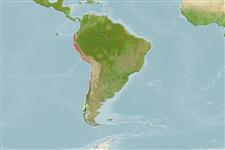
marino demersale; distribuzione batimetrica 16 - 211 m, usually 70 - 100 m (Ref. 9253). Tropical; 1°N - 45°S, 83°W - 70°W
Southeast Pacific: Ecuador to southern Chile.
Dimensione / Peso / Età
Maturità: Lm ? range ? - ? cm
Max length : 87.0 cm TL (female)
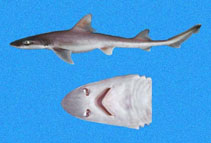
An offshore bottom-dwelling shark found on the continental shelf. Prefers rocky bottom around islands. Feeds on crabs, mantis shrimp, and small bony fishes. Viviparous, with 5 to 10 young per litter. Size at birth about 25 cm.
Ciclo vitale e comportamento di accoppiamento
Maturità | Riproduzione | Deposizione | Uova | Fecondità | Larve
Viviparous (Ref. 244). Distinct pairing with embrace (Ref. 205).
Compagno, L.J.V., 1984. FAO Species Catalogue. Vol. 4. Sharks of the world. An annotated and illustrated catalogue of shark species known to date. Part 2 - Carcharhiniformes. FAO Fish. Synop. 125(4/2):251-655. Rome: FAO. (Ref. 244)
Stato della Lista Rossa IUCN (Ref. 130435: Version 2025-2 (Global))
Minaccia per l'uomo
Harmless
Usi umani
Pesca: elevato interesse commerciale; Pesce da pesca sportiva: si
Strumenti
Rapporti speciali
Scarica XML
Fonti Internet
Stime basate su modelli
Temperatura preferita (Fonte Biblio.
123201): 12.6 - 15.6, mean 15 °C (based on 15 cells).
Indice di diversità filogenetica (Fonte Biblio.
82804): PD
50 = 0.5000 [Uniqueness, from 0.5 = low to 2.0 = high].
Bayesian length-weight: a=0.00229 (0.00107 - 0.00491), b=3.14 (2.97 - 3.31), in cm total length, based on LWR estimates for this Genus-body shape (Ref.
93245).
Livello trofico (Fonte Biblio.
69278): 3.7 ±0.0 se; based on diet studies.
Resilienza (Fonte Biblio.
120179): Molto basso, tempo minimo di raddoppiamento della popolazione più di 14 anni (Fec=4).
Vulnerabilità della pesca (Ref.
59153): Moderate to high vulnerability (55 of 100).
🛈
Nutrienti (Ref.
124155): Calcium = 33.5 [9.6, 163.5] mg/100g; Iron = 0.511 [0.154, 1.840] mg/100g; Protein = 21 [19, 23] %; Omega3 = 0.0958 [, ] g/100g; Selenium = 83 [22, 289] μg/100g; VitaminA = 13.1 [5.0, 32.5] μg/100g; Zinc = 0.954 [0.422, 1.897] mg/100g (wet weight);