Classification / Noms
Noms communs | Synonymes | Catalog of Fishes(Genre, Espèce) | ITIS | CoL | WoRMS | Cloffa
>
Alepocephaliformes (Slickheads and tubeshoulders) >
Platytroctidae (Tubeshoulders)
Etymology: Mentodus: Latin, mentum = beard, chin + Greek, odous = teeth; eubranchus: From the Greek eu, good, and branchos, gill, in reference to the relatively long gill filaments.
More on authors: Matsui & Rosenblatt.
Environnement : milieu / zone climatique / profondeur / gamme de distribution
Écologie
marin bathypélagique; profondeur ? - 1000 m (Ref. 96339). Deep-water; 36°N - 18°N
Eastern Pacific: off central California, USA to off the west coast of Mexico. One record from the Northwest Pacific.
Taille / Poids / Âge
Maturité: Lm ? range ? - ? cm
Max length : 11.4 cm SL mâle / non sexé; (Ref. 10887)
Description synthétique
Clés d'identification | Morphologie | Morphométrie
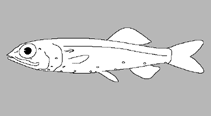
Épines dorsales (Total) : 0; Rayons mous dorsaux (Total) : 17 - 19; Épines anales: 0; Rayons mous anaux: 15 - 16; Vertèbres: 42 - 44. No preoperculomandibular or postocular canals. Infraorbital canal restricted to lacrimal and ventral margin of eye. Supraorbital canal extending from just in front of eye to just behind eye. Snout short, about half to three-fourths eye length. Nasal sac nearly bordering maxilla. Premaxillary tusk single and slightly larger than other teeth. No teeth on mesopterygoid and on upper pharyngeals of 2nd arch. Gill filaments relatively well developed for a platyroctid, outer row at angle of 1st arch 0.5-1.2% SL. Bases of filaments united at membrane, which at angle of 1st arch is one-third to one-fourth the length of inner filaments. Scales 56-62 in midlateral series. Dorsal margin of gill opening 1-3 (usually 2) scale rows above the opening of shoulder organ (about level with mideye). Eye large, 11% SL at about 100 mm SL, its lateral bulge usually about in line with the widest part of skull at sphenotic or barely beyond it. Cleithral symphysis normal, not ending in a spine.
Bathypelagic below 1000 m (Ref. 58302).
Cycle de vie et comportement reproducteur
Maturité | Reproduction | Frai | Œufs | Fécondité | Larves
Matsui, T. and R.H. Rosenblatt, 1987. Review of the deep-sea fish family Platytroctidae (Pisces: Salmoniformes). Bull. Scripps Inst. Oceanogr. 26(1-7):1-159. (Ref. 10887)
Statut dans la liste rouge de l'IUCN (Ref. 130435: Version 2025-2 (Global))
Menace pour l'homme
Harmless
Utilisations par l'homme
Outils
Articles particuliers
Télécharger en XML
Sources Internet
Estimations basées sur des modèles
Indice de diversité phylogénétique (Réf.
82804): PD
50 = 0.5039 [Uniqueness, from 0.5 = low to 2.0 = high].
Bayesian length-weight: a=0.00407 (0.00158 - 0.01051), b=3.17 (2.94 - 3.40), in cm total length, based on LWR estimates for this (Sub)family-body shape (Ref.
93245).
Niveau trophique (Réf.
69278): 3.3 ±0.5 se; based on size and trophs of closest relatives
Résilience (Réf.
120179): Haut, temps minimum de doublement de population inférieur à 15 mois (Preliminary K or Fecundity.).
Vulnérabilité de la pêche (Ref.
59153): Low vulnerability (10 of 100).
🛈