Elasmobranchii (tubarões e raias) (sharks and rays) >
Carcharhiniformes (Ground sharks) >
Proscylliidae (Finback catsharks)
Etymology: Proscyllium: pro (L.), in front of, probably referring to far forward placement of dorsal fin compared with Scyllium (=Scyliorhinus, Scyliorhinidae) (See ETYFish); habereri: In honor of German physician, anthropologist and natural history collector Karl Albert Haberer (1864-1941), who collected holotype (See ETYFish).
Eponymy: Dr Karl Albert Haberer (1864–1941) was an independent German anthropologist, naturalist, student of politics, and collector in Japan and China. [...] (Ref. 128868), visit book page.
More on author: Hilgendorf.
Meio ambiente: milieu / Zona climática / intervalo de profundidade / faixa de distribuição
Ecologia
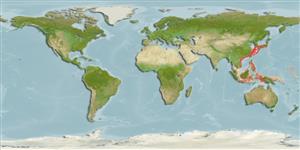
marinhas demersal; intervalo de profundidade 50 - 100 m (Ref. 244). Tropical; 39°N - 8°S
Western Pacific: southeastern Japan to Viet Nam and northwestern Java, Indonesia (Ref. 13566).
Tamanho / Peso / Idade
Maturidade: Lm ? range ? - ? cm
Max length : 57.0 cm TL macho/indeterminado; (Ref. 244); 65.0 cm TL (female)
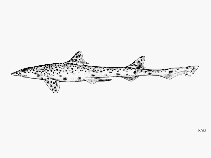
Espinhos dorsais (total) : 0; Espinhos anais: 0. Caudal fin without a rippled dorsal margin and ventral lobe but with a strong subterminal notch; vertebral axis of caudal fin little raised above body axis (Ref. 13566). Round dark brown spots and indistinct saddles (Ref. 13566).
Body shape (shape guide): elongated.
A little-known, uncommon bottom-dwelling shark found on the shelves of continental and insular waters (Ref. 244). Dwell on the sublittoral zone, 50-320 m (Ref. 11230). Food habits little known; probably feeding on bony fishes, crustaceans and cephalopods (Ref. 244). Oviparous (Ref. 50449), with 1 to 2 pups in a litter (Ref. 244).
Ciclo de vida ou comportamento de acasalamento
Maturidade | Reprodução | Desova | Ovos | Fecundidade | Larvas
Oviparous, with a single egg deposited per uterus (Ref. 244). Embryos feed solely on yolk (Ref. 50449).
Compagno, L.J.V., 1984. FAO Species Catalogue. Vol. 4. Sharks of the world. An annotated and illustrated catalogue of shark species known to date. Part 2 - Carcharhiniformes. FAO Fish. Synop. 125(4/2):251-655. Rome: FAO. (Ref. 244)
Status na Lista Vermelha da UICN (Ref. 130435: Version 2025-2 (Global))
Uso pelos humanos
Pescarias: pesca de subsistência
Ferramentas
Relatórios especiais
Baixar XML
Fontes da internet
Estimativas baseadas em modelos
Temperatura preferida (Ref.
123201): 17.4 - 28, mean 25.1 °C (based on 134 cells).
Índice de diversidade filogenética (Ref.
82804): PD
50 = 0.6328 [Uniqueness, from 0.5 = low to 2.0 = high].
Bayesian length-weight: a=0.00288 (0.00112 - 0.00741), b=3.14 (2.91 - 3.37), in cm total length, based on LWR estimates for this (Sub)family-body shape (Ref.
93245).
Nível Trófico (Ref.
69278): 4.1 ±0.57 se; based on food items.
Resiliência (Ref.
120179): Muito baixo(a), tempo mínimo de duplicação da população maior que 14 anos (Fec = 1-2).
Vulnerabilidade da pesca (Ref.
59153): Moderate to high vulnerability (46 of 100).
🛈