sub class Elasmobranchii (ฉลามและกระเบน) (sharks and rays) >
Carcharhiniformes (Ground sharks) >
Pseudotriakidae (False catsharks)
Etymology: Gollum: Named for the antihero of Tolkien’s “Lord of the Rings” trilogy, to which G. attenuatus “bears some resemblance in form and habits” (See ETYFish); attenuatus: Latin for drawn out or tapered, refer- ring to its “attenuate, almost anguilliform as though emaciated” shape (See ETYFish).
Eponymy: The genus and these species are named after the fictional character, Gollum, in J R R Tolkien’s The Hobbit and Lord of the Rings. [...] (Ref. 128868), visit book page.
สิ่งแวดล้อม : สิ่งแวดล้อม / เขตภูมิอากาศ / ระดับความลึก / ระยะการกระจายสินค้า
นิเวศวิทยา
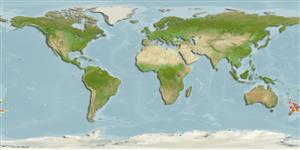
เกี่ยวกับทะเล,น้ำเค็ม สัตว์หน้าดินในเขตน้ำลึก; ระดับความลึก 120 - 660 m (Ref. 26346), usually 400 - 600 m (Ref. 13566). Deep-water; - 46°S
Southwest Pacific: occurs off New Zealand and on rises between New Zealand and the east coast of Australia, New Caledonia, and Fiji just south of the Western Central Pacific. Placement in Proscyllidae provisional, probably will be relocated in Pseudotriakidae.
ความยาวเมื่อครบกำหนดครั้งแรก / ขนาด / น้ำหนัก / อายุ
วัยเจริญพันธุ์: Lm ?, range 70 - ? cm
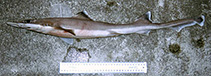
Max length : 107 cm TL เพศผู้/กระเทย; (Ref. 6893); 109.2 cm TL (female)
เงี่ยงครีบหลัง (รวม) : 0; เงี่ยงครีบก้น: 0. Caudal fin without a rippled dorsal margin and ventral lobe but with a strong subterminal notch; vertebral axis of caudal fin little raised above body axis (Ref. 13566).
Body shape (shape guide): elongated.
An uncommon to common deep-water bottom-dwelling shark found on the outermost continental shelf and upper slope of New Zealand and on adjacent seamounts and submarine banks (Ref. 13566). Seems adapted to waters of about 10°C and 34.8 ppt salinity (Ref. 6893). Feeds on a wide variety of fishes, cephalopods, and other invertebrates (Ref. 13566). Probably in schools (Ref. 13566). Females grow slightly larger than males (Ref. 13566). Ovoviviparous, embryos feeding on yolk sac and other ova produced by the mother, uterine milk is consumed additionally (Ref. 50449). Two young are born per litter (Ref. 13566).
Exhibit ovoviparity (aplacental viviparity), embryos feed on yolk and ova, also consume uterine milk (Ref. 50449). With usually 2 young per litter (Ref. 13566). Fetuses eat unfertilized eggs and store consumed yolk in their yolk sacs (Ref. 13566). Distinct pairing with embrace (Ref. 205).
Compagno, L.J.V., 1984. FAO Species Catalogue. Vol. 4. Sharks of the world. An annotated and illustrated catalogue of shark species known to date. Part 2 - Carcharhiniformes. FAO Fish. Synop. 125(4/2):251-655. Rome: FAO. (Ref. 244)
สถานะบัญชีแดงของ IUCN (Ref. 130435: Version 2025-2 (Global))
การใช้ของมนุษย์
การประมง: ไม่มีผลประโยชน์
เครื่องมือ
รายงานพิเศษ
ดาวน์โหลด XML
แหล่งที่มาจากอินเตอร์เน็ต
การประมาณค่าตามแบบจำลอง
อุณหภูมิที่ต้องการ (อ้างอิง
123201): 7.9 - 10.1, mean 9.5 °C (based on 24 cells).
ดัชนีความหลากหลายทางวิวัฒนาการ (อ้างอิง
82804): PD
50 = 0.7812 [Uniqueness, from 0.5 = low to 2.0 = high].
Bayesian length-weight: a=0.00209 (0.00113 - 0.00386), b=3.21 (3.04 - 3.38), in cm total length, based on LWR estimates for this species & (Sub)family-body (Ref.
93245).
ระดับชั้นอาหาร (อ้างอิง
69278): 4.2 ±0.4 se; based on diet studies.
ความสามารถในการกลับคืนสู่ปกติ (อ้างอิง
120179): ต่ำมาก, เวลาต่ำสุดที่จะทำให้ประชากรเพิ่มขึ้นเป็น 2 เท่าใช้เวลามากกว่า 14 ปี (Fec=2).
ความเสี่ยงต่อการตกปลา (Ref.
59153): High to very high vulnerability (66 of 100).
🛈