>
Perciformes/Scorpaenoidei (Scorpionfishes) >
Triglidae (Searobins) > Pterygotriglinae
Etymology: Pterygotrigla: Greek, pterigion, diminutive of pteryx = wing, fin + Greek, trigla, es = red mullet (Ref. 45335).
Eponymy: Thomas Anderton worked at the Port Chalmers fish hatchery, New Zealand. [...] (Ref. 128868), visit book page.
More on author: Waite.
Environnement : milieu / zone climatique / profondeur / gamme de distribution
Écologie
marin bathydémersal; profondeur 90 - 500 m (Ref. 9771), usually 200 - 500 m (Ref. 9771). Deep-water
Distribution
Territoires | Zones FAO | Écosystèmes | Occurrences | Carte par point | Introductions | Faunafri
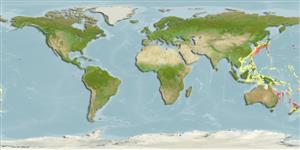
Western Pacific: New Caledonia, New Zealand (North and South Islands); eastward on the Challenger Plateau (but not been taken around the Chatham Is.), Australia (from Saumarez Reef (Queensland) to Bass Strait; unconfirmed report from the center of the Great Australian Bight west to Fremantle, Western Australia)
Taille / Poids / Âge
Maturité: Lm ? range ? - ? cm
Max length : 38.0 cm SL mâle / non sexé; (Ref. 9771)
Description synthétique
Clés d'identification | Morphologie | Morphométrie
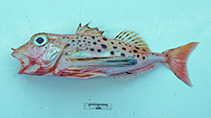
Head large, triangular. No spines around orbit; nasal spine absent, opercular spine long, nuchal spine long, rostral spines strong but short, no antrorse rostral spine, cleithral spine long. Base of first dorsal fin with 10 flat plates, first plate extends in advance of first dorsal-fin spine. Lateral line scales small, more than 70 rows. Head and dorsum covered with prominent black spots.
Body shape (shape guide): fusiform / normal.
Found on the continental shelf and continental slope. Benthic (Ref. 75154). Excellent food fish but rarely caught (Ref. 9771).
Cycle de vie et comportement reproducteur
Maturité | Reproduction | Frai | Œufs | Fécondité | Larves
Richards, W.J., 1999. Triglidae. Gurnards, sea robins, armored gurnards, and armored sea robins. p. 2359-2363. In K.E. Carpenter and V.H. Niem (eds.) FAO species identification guide for fishery purposes. The living marine resources of the WCP. Vol. 4. Bony fishes part 2 (Mugilidae to Carangidae). FAO, Rome. (Ref. 9771)
Statut dans la liste rouge de l'IUCN (Ref. 130435: Version 2025-2 (Global))
Menace pour l'homme
Harmless
Utilisations par l'homme
Pêcheries: pêcheries vivrières
Outils
Articles particuliers
Télécharger en XML
Sources Internet
Estimations basées sur des modèles
Température préférée (Réf.
123201): 10.2 - 18.9, mean 14.3 °C (based on 50 cells).
Indice de diversité phylogénétique (Réf.
82804): PD
50 = 0.5000 [Uniqueness, from 0.5 = low to 2.0 = high].
Bayesian length-weight: a=0.00955 (0.00411 - 0.02221), b=3.05 (2.84 - 3.26), in cm total length, based on LWR estimates for this (Sub)family-body shape (Ref.
93245).
Niveau trophique (Réf.
69278): 3.8 ±0.6 se; based on size and trophs of closest relatives
Résilience (Réf.
120179): Milieu, temps minimum de doublement de population : 1,4 à 4,4 années (Preliminary K or Fecundity.).
Vulnérabilité de la pêche (Ref.
59153): Moderate vulnerability (36 of 100).
🛈