Elasmobranchii (Haie und Rochen) (sharks and rays) >
Lamniformes (Mackerel sharks) >
Mitsukurinidae (Goblin shark)
Etymology: Mitsukurina: -ina (L.), belonging to: University of Tokyo zoologist Kakichi Mitsukuri (1858-1909), who placed holotype (provided by Alan Owson, see species) of this “very remarkable shark” in Jordan’s “hands to be identified, figured, and described” (See ETYFish); owstoni: In honor of Alan Owston (1853-1915), English businessman, yachtsman, collector of Asian wildlife, and resident of Yokohama, Japan, who secured holotype from a fisherman (named for Owston at the request of Kakichi Mitsukuri, see genus) (See ETYFish).
Eponymy: Dr Kakichi Mitsukuri (1857–1909) was a Japanese zoologist who first went to the USA (1873) and achieved doctorates from Yale (1879) and from Johns Hopkins University (1883). [...] Alan Owston (1853–1915) was an English businessman who was a collector of Asian wildlife, as well as a yachtsman. [...] (Ref. 128868), visit book page.
More on author: Jordan.
Umwelt: Milieu / Klimazone / Tiefenbereich / Verbreitungsgebiet
Ökologie
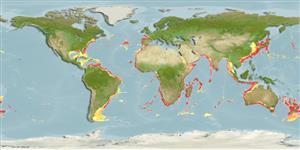
seewasser bathydemersal; tiefenbereich 30 - 1300 m (Ref. 43278), usually 270 - 960 m (Ref. 43278). Deep-water; 48°N - 55°S, 180°W - 180°E
Western Atlantic: Guyana (Ref. 6871), Suriname (Ref. 13608, 11228) and French Guiana. Eastern Atlantic: France (Bay of Biscay), Madeira, Portugal, and South Africa. Western Indian Ocean: off South Africa. Western Pacific: Japan, Australia (South Australia, New South Wales), New Zealand (Ref. 26346). Eastern Pacific: USA (southern California) (Ref. 43278).
Länge bei der ersten Reifung / Größe / Gewicht / Alter
Geschlechtsreife: Lm 293.0, range 264 - 322 cm
Max length : 617 cm TL Männchen/unbestimmt; (Ref. 83323); common length : 200 cm TL Männchen/unbestimmt; (Ref. 5217)
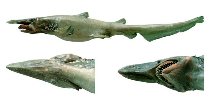
Rückenflossenstacheln (insgesamt) : 0; Afterflossenstacheln: 0. Flat, bladelike, elongated snout, tiny eyes without nictitating eyelids, soft, flabby body, slender, very long cusped teeth in long, protrusible jaws, long caudal fin without a ventral lobe (Ref. 247). Pinkish-white with bluish fins, becoming brownish grey after death (Ref. 5578, 11228).
Body shape (shape guide): elongated.
Found on outer continental shelves and upper slopes, but rarely in shallow water close inshore (Ref. 247, 43278). Jaws are highly specialized for rapid projection from the head to snap up small animals (Ref. 247). Feeds on jacopever, pelagic octopus and crabs (Ref. 5578). Ovoviviparous, embryos feeding on yolk sac and other ova produced by the mother (Ref. 50449). Probably slow-moving and neutrally buoyant (Ref. 6871). Utilized dried salted (Ref. 247)
Lebenszyklus und Paarungsverhalten
Geschlechtsreife | Fortpflanzung | Ablaichen | Eier | Fruchtbarkeit | Larven
Exhibit ovoviparity (aplacental viviparity), with embryos feeding on other ova produced by the mother (oophagy) after the yolk sac is absorbed (Ref. 247, 50449). Distinct pairing with embrace (Ref. 205).
Compagno, L.J.V., 1984. FAO Species Catalogue. Vol. 4. Sharks of the world. An annotated and illustrated catalogue of shark species known to date. Part 1 - Hexanchiformes to Lamniformes. FAO Fish. Synop. 125(4/1):1-249. Rome, FAO. (Ref. 247)
IUCN Rote Liste Status (Ref. 130435: Version 2025-2 (Global))
Nutzung durch Menschen
Fischereien: bycatch
Tools
Zusatzinformationen
Download XML
Internet Quellen
Schätzungen auf der Grundlage von Modellen
Bevorzugte Temperatur (Ref.
123201): 3.8 - 13.7, mean 8.3 °C (based on 1037 cells).
Phylogenetischer Diversitätsindex (Ref.
82804): PD
50 = 1.5000 [Uniqueness, from 0.5 = low to 2.0 = high].
Bayesian length-weight: a=0.00389 (0.00180 - 0.00842), b=3.12 (2.94 - 3.30), in cm total length, based on all LWR estimates for this body shape (Ref.
93245).
Trophische Ebene (Ref.
69278): 4.1 ±0.62 se; based on food items.
Widerstandsfähigkeit (Ref.
120179): sehr niedrig, Verdopplung der Population dauert mehr als 14 Jahre. (Fec assumed to be <10).
Anfälligkeit der Fischerei (Ref.
59153): Very high vulnerability (90 of 100).
🛈