>
Gobiiformes (Gobies) >
Odontobutidae (Freshwater sleepers)
Etymology: hikimius: Named for the group name "Hikimi" that Sakai et al., 1998, used for one of the species groups of O. obscura.
Environnement : milieu / zone climatique / profondeur / gamme de distribution
Écologie
; eau douce benthopélagique. Boreal
Asia: Japan.
Taille / Poids / Âge
Maturité: Lm ? range ? - ? cm
Max length : 15.6 cm SL mâle / non sexé; (Ref. 41509); 15.5 cm SL (female)
Description synthétique
Clés d'identification | Morphologie | Morphométrie
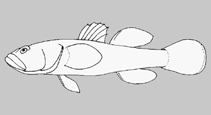
Épines dorsales (Total) : 8; Rayons mous dorsaux (Total) : 9; Épines anales: 1; Rayons mous anaux: 7; Vertèbres: 32 - 33. Connection present between lower end of transverse sensory papillae row (papillae group 17) and lower part of longitudinal sensory papillae row (papillae group 19) on opercle, separate in all congeners. Upper and lower branched caudal fin rays 8 + 7 (7-8 +6-8); upper and lower segmented caudal fin rays 9 + 8 (9-10+8). Head depressed. Mouth large, obliquely upwards (Ref. 41509).
Body shape (shape guide): fusiform / normal; Cross section: circular.
Cycle de vie et comportement reproducteur
Maturité | Reproduction | Frai | Œufs | Fécondité | Larves
Iwata, A. and H. Sakai, 2002. Odontobutis hikimius n. sp.: a new freshwater goby from Japan, with a key to species of the genus. Copeia 2002(1):104-110. (Ref. 41509)
Statut dans la liste rouge de l'IUCN (Ref. 130435: Version 2025-2 (Global))
Menace pour l'homme
Harmless
Utilisations par l'homme
Outils
Articles particuliers
Télécharger en XML
Sources Internet
Estimations basées sur des modèles
Indice de diversité phylogénétique (Réf.
82804): PD
50 = 0.5039 [Uniqueness, from 0.5 = low to 2.0 = high].
Bayesian length-weight: a=0.00977 (0.00434 - 0.02202), b=3.10 (2.91 - 3.29), in cm total length, based on LWR estimates for this (Sub)family-body shape (Ref.
93245).
Niveau trophique (Réf.
69278): 3.2 ±0.5 se; based on size and trophs of closest relatives
Résilience (Réf.
120179): Faible, temps minimum de doublement de population : 4,5 à 14 années (Preliminary K or Fecundity.).
Vulnérabilité de la pêche (Ref.
59153): Low vulnerability (10 of 100).
🛈