Elasmobranchii (hajar och rockor) (sharks and rays) >
Lamniformes (Mackerel sharks) >
Megachasmidae (Megamouth sharks)
Etymology: Megachasma: megas (Gr.), large; chasma (Gr.), yawning hole or open mouth, referring to its unusually large oral cavity (See ETYFish); pelagios: Greek for “of the sea,” referring to its oceanic, epipelagic habitat (See ETYFish).
Miljö: miljö / Klimatzon / djupintervall / distributionsområde
Ekologi
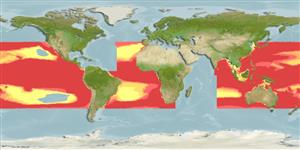
marina pelagic-oceanic; havsvandrande (Ref. 51243); djupintervall 5 - 600 m (Ref. 58302), usually 120 - 166 m (Ref. 48844). Deep-water; 40°N - 40°S, 180°W - 180°E
Pacific Ocean: Japan, Indonesia, Philippines, Hawaii and California, USA. Atlantic Ocean: Brazil and Senegal.
Längd vid första mognad / Storlek / Vikt / Ålder
Könsmognad: Lm ?, range 540 - ? cm
Max length : 549 cm TL hane/ej könsbestämd; (Ref. 85838); 709.0 cm TL (female)
Kort beskrivning
Bestämningsnycklar | Morfologi | Morfometri
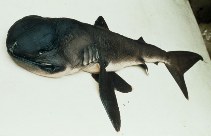
Taggstrålar i ryggfenan (totalt) : 0; Ryggkotor: 125. Body stout, tapering posteriorly (Ref. 6871), tadpole-like with larger head and tapering trunk and tail (Ref. 47786). Snout extremely short but broadly rounded (Ref 43278, 47786). Head huge, blubbery (Ref. 6871). Mouth very broad and terminal on head, with corner extending behind the eyes (Ref. 6871, 43278). Jaws huge, protrusible anteriorly but not greatly distensible laterally (Ref. 43278, 47786), lower jaw extending to snout tip (Ref. 6871). Teeth very small, numerous, hooked (Ref. 43278, 6871, 47787). Gill slits moderately long, not reaching dorsal surface of head (Ref. 6871; 43278), internal gill slits lined with dense rows of papillose gill rakers (Ref. 43278). Eyes semicircular (Ref. 47786), with no nictitating membrane (Ref. 43278, 6871, 47786). Two dorsal fins, relatively low and angular; small anal fin; long, narrow pectoral fins; moderate-sized pelvic fin; caudal fin asymmetrical, non-lunate, with a short and strong ventral lobe; upper pre-caudal pit only; caudal peduncle without keels or ridges (Ref, 6871, 43278).
Body shape (shape guide): elongated.
Oceanic, possibly occurring in depths between 150 and 1,000 m (Ref. 6871). Epi- and mesopelagic (Ref. 58302). Feeds on planktivorous prey such as euphausiid shrimps, copepods and jellyfish (Ref. 6871). May also eat small midwater fishes. Ovoviviparous (Ref. 50449). Possibly less active than the basking and whale sharks (Ref. 6871). Its feeding habits and habitat suggest that it may be a rare catch in the future. Ovoviviparous, embryos feeding on yolk sac and other ova produced by the mother (Ref. 50449). Males mature by 400 cm (Ref. 6871). A bright white band on the snout just above the upper jaw may play a role in feeding behavior or with recognition of individuals (Ref. 47761). Preyed on by the semi-parasitic cookiecutter shark, Isistius brasiliensis.
Livscykel och parningsbeteende
Könsmognad | Reproduktion | Lek | Ägg | Fekunditet | Larver
Exhibit ovoviparity (aplacental viviparity), with embryos feeding on other ova produced by the mother (oophagy) after the yolk sac is absorbed (Ref. 50449). Distinct pairing with embrace (Ref. 205). Size at birth <177 cm (Ref. 85838).
Compagno, L.J.V., 1984. FAO Species Catalogue. Vol. 4. Sharks of the world. An annotated and illustrated catalogue of shark species known to date. Part 1 - Hexanchiformes to Lamniformes. FAO Fish. Synop. 125(4/1):1-249. Rome, FAO. (Ref. 247)
Status på IUCN:s rödlista (Ref. 130435: Version 2025-2 (Global))
Hot mot människor
Harmless
Mänskliga användningsområden
Fiskeri: saknar intresse
Verktyg
Särskilda rapporter
Ladda ner XML
Internet-källor
Uppskattningar baserade på modeller
Önskad temperatur (Ref.
123201): 9.7 - 23, mean 17.8 °C (based on 247 cells).
Index för fylogenetisk mångfald (Ref.
82804): PD
50 = 1.5000 [Uniqueness, from 0.5 = low to 2.0 = high].
Bayesian length-weight: a=0.00389 (0.00180 - 0.00842), b=3.12 (2.94 - 3.30), in cm total length, based on all LWR estimates for this body shape (Ref.
93245).
Trofisk nivå (Ref.
69278): 3.4 ±0.2 se; based on diet studies.
Resiliens (Ref.
120179): Mycket låg, lägsta populationsfördubblingstid mer än 14 år (Fec assumed to be <10).
Sårbarhet i fisket (Ref.
59153): Very high vulnerability (90 of 100).
🛈