Elasmobranchii (tubarões e raias) (sharks and rays) >
Orectolobiformes (Carpet sharks) >
Hemiscylliidae (Bamboo sharks)
Etymology: Hemiscyllium: hemi-, from hemisys (Gr.), half, presumably referring to similarity and/ or close affinity to Scyllium (=Scyliorhinus, now in Scyliorhinidae) and/or Chiloscyllium; skylion, Greek for dogfish or small shark (See ETYFish); trispeculare: tri-, from tres (L.), three; specularis (L.), watchful or looking, referring to three eyespots (ocelli) on shoulder (See ETYFish).
More on author: Richardson.
Ambiente: milieu / zona climática / intervalo de profundidade / gama de distribuição
Ecologia
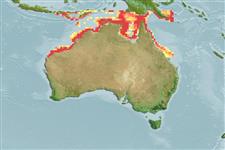
marinhas associadas(os) a recifes; intervalo de profundidade 0 - 50 m (Ref. 54542). Tropical; 8°S - 22°S, 114°E - 152°E (Ref. 54542)
Western Pacific: northern Australia (including Western Australia) (Ref. 6871). Possibly in the Mollucas (Indonesia).
Comprimento na primeira maturidade / Tamanho / Peso / Idade
Maturidade: Lm ?, range 53 - ? cm
Max length : 79.0 cm TL macho/indeterminado; (Ref. 43278)
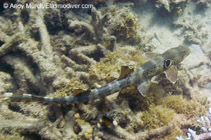
Espinhos dorsais (total) : 0; Espinhos anais: 0. Body covered with numerous, densely clustered dark, small and large spots that form a reticular network of light ground color between them; dark crossbands strong on ventral surface of tail (Ref. 13575).
Body shape (shape guide): elongated.
Found on shallow coral reefs of the continental shelf (Ref. 247). Probably mainly feeding on benthic invertebrates (Ref. 6871). Oviparous (Ref. 50449).
Ciclo de vida e comportamento de acasalamento
Maturidade | Reprodução | Desova | Ovos | Fecundidade | Larvas
Oviparous, paired eggs are laid. Embryos feed solely on yolk (Ref. 50449).
Compagno, L.J.V., 1984. FAO Species Catalogue. Vol. 4. Sharks of the world. An annotated and illustrated catalogue of shark species known to date. Part 1 - Hexanchiformes to Lamniformes. FAO Fish. Synop. 125(4/1):1-249. Rome, FAO. (Ref. 247)
Categoria na Lista Vermelha da IUCN (Ref. 130435: Version 2025-2 (Global))
Utilização humana
Pescarias: pouco comercial
Ferramentas
Relatórios especiais
Descarregue XML
Fontes da internet
Estimativas baseadas em modelos
Temperatura preferida (Ref.
123201): 26.9 - 28.7, mean 27.9 °C (based on 210 cells).
Índice de diversidade filogenética (Ref.
82804): PD
50 = 0.5020 [Uniqueness, from 0.5 = low to 2.0 = high].
Bayesian length-weight: a=0.00407 (0.00182 - 0.00914), b=3.09 (2.89 - 3.29), in cm total length, based on LWR estimates for this (Sub)family-body shape (Ref.
93245).
Nível Trófico (Ref.
69278): 3.5 ±0.37 se; based on food items.
Resiliência (Ref.
120179): Baixo, tempo mínimo de duplicação da população 4,5 - 14 anos (Fec assumed to be <100).
Vulnerabilidade da pesca (Ref.
59153): Moderate to high vulnerability (52 of 100).
🛈
Nutrientes (Ref.
124155): Calcium = 16.1 [3.1, 60.5] mg/100g; Iron = 0.407 [0.100, 1.103] mg/100g; Protein = 19.3 [17.1, 21.3] %; Omega3 = 0.0839 [, ] g/100g; Selenium = 28.1 [8.7, 78.1] μg/100g; VitaminA = 56.1 [19.8, 149.3] μg/100g; Zinc = 0.984 [0.482, 2.033] mg/100g (wet weight);