>
Perciformes/Scorpaenoidei (Scorpionfishes) >
Aploactinidae (Velvetfishes)
Etymology: Xenaploactis: Greek, xenos = strange + Greek, aplos = double + Greek, aktis, -inos = ray (Ref. 45335); anopta: From 'anoptos' means unseen.
Environnement : milieu / zone climatique / profondeur / gamme de distribution
Écologie
marin démersal; profondeur 64 - 81 m (Ref. 35984). Tropical
Distribution
Territoires | Zones FAO | Écosystèmes | Occurrences | Carte par point | Introductions | Faunafri
Western Central Pacific: Philippines.
Taille / Poids / Âge
Maturité: Lm ? range ? - ? cm
Max length : 3.7 cm SL mâle / non sexé; (Ref. 35984)
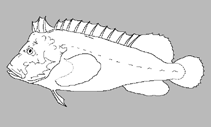
Épines dorsales (Total) : 13; Rayons mous dorsaux (Total) : 8; Épines anales: 1; Rayons mous anaux: 9; Vertèbres: 27. Body densely covered with modified scales which form spinous points, best developed anteriorly; depth greater than 1/3 SL.. Lachrymal with 2 strong sharp spines, the first notably curved. Second infraorbital bone without spines, a prominent elongate slit lateral line pore. Uppermost preopercular lateral-line pores with finger-like cirri. Mouth very strongly upturned. Interorbit with prominent ridges, divergent anteriorly, convergent over middle of interorbit, strongly divergent posteriorly (Ref. 35984, 39602).
Cycle de vie et comportement reproducteur
Maturité | Reproduction | Frai | Œufs | Fécondité | Larves
Poss, S.G. and W.N. Eschmeyer, 1980. Xenaploactis, a new genus for Prosopodasys asperrimus Günther (Pisces: Aploactinidae), with descriptions of two new species. Proc. Calif. Acad. Sci. 42(8):287-293. (Ref. 35984)
Statut dans la liste rouge de l'IUCN (Ref. 130435: Version 2025-2 (Global))
Menace pour l'homme
Harmless
Utilisations par l'homme
Outils
Articles particuliers
Télécharger en XML
Sources Internet
Estimations basées sur des modèles
Indice de diversité phylogénétique (Réf.
82804): PD
50 = 0.6250 [Uniqueness, from 0.5 = low to 2.0 = high].
Bayesian length-weight: a=0.00631 (0.00252 - 0.01577), b=3.13 (2.91 - 3.35), in cm total length, based on LWR estimates for this (Sub)family-body shape (Ref.
93245).
Niveau trophique (Réf.
69278): 3.2 ±0.3 se; based on size and trophs of closest relatives
Vulnérabilité de la pêche (Ref.
59153): Low vulnerability (10 of 100).
🛈