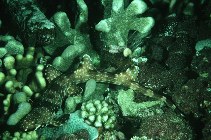
Elasmobranchii (tubarões e raias) (sharks and rays) >
Orectolobiformes (Carpet sharks) >
Hemiscylliidae (Bamboo sharks)
Etymology: Hemiscyllium: hemi-, from hemisys (Gr.), half, presumably referring to similarity and/ or close affinity to Scyllium (=Scyliorhinus, now in Scyliorhinidae) and/or Chiloscyllium; skylion, Greek for dogfish or small shark (See ETYFish); strahani: In honor of Australian zoologist Ronald Strahan (1922-2010), director of Taronga Zoological Park (Sydney), where holotype lived in captivity (See ETYFish).
Eponymy: Dr Ronald Strahan (1922–2010) was an Australian zoologist, ichthyologist and research scientist who was Director of Taronga Park Zoo, Sydney (1967–1974) when the carpetshark was described; the holotype had been swimming in the zoo’s aquarium since [...] (Ref. 128868), visit book page.
More on author: Whitley.
Ambiente: milieu / zona climática / intervalo de profundidade / gama de distribuição
Ecologia
marinhas associadas(os) a recifes; intervalo de profundidade 3 - 18 m (Ref. 43278), usually 3 - 13 m (Ref. 43278). Tropical; 5°S - 10°S, 144°E - 153°E
Western Pacific: Papua New Guinea. Also reported from Indonesia (questionable occurrence).
Tamanho / Peso / Idade
Maturidade: Lm ? range ? - ? cm
Max length : 80.0 cm TL macho/indeterminado; (Ref. 106604)
Espinhos dorsais (total) : 0; Espinhos anais: 0. Caudal fin with a pronounced subterminal notch but without a ventral lobe (Ref. 13575). Head and snout with an abrupt black hood; body with conspicuous large white spots (Ref. 13575).
Body shape (shape guide): elongated.
A little-known inshore bottom shark of singular and unique appearance (Ref. 247). Probably found on coral reefs (Ref. 247). Oviparous (Ref. 50449).
Ciclo de vida e comportamento de acasalamento
Maturidade | Reprodução | Desova | Ovos | Fecundidade | Larvas
Oviparous, paired eggs are laid. Embryos feed solely on yolk (Ref. 50449).
Compagno, L.J.V., 1984. FAO Species Catalogue. Vol. 4. Sharks of the world. An annotated and illustrated catalogue of shark species known to date. Part 1 - Hexanchiformes to Lamniformes. FAO Fish. Synop. 125(4/1):1-249. Rome, FAO. (Ref. 247)
Categoria na Lista Vermelha da IUCN (Ref. 130435: Version 2025-2 (Global))
Ameaça para o homem
Harmless
Utilização humana
Pescarias: pouco comercial
Ferramentas
Relatórios especiais
Descarregue XML
Fontes da internet
Estimativas baseadas em modelos
Índice de diversidade filogenética (Ref.
82804): PD
50 = 0.5020 [Uniqueness, from 0.5 = low to 2.0 = high].
Bayesian length-weight: a=0.00407 (0.00182 - 0.00914), b=3.09 (2.89 - 3.29), in cm total length, based on LWR estimates for this (Sub)family-body shape (Ref.
93245).
Nível Trófico (Ref.
69278): 3.5 ±0.3 se; based on size and trophs of closest relatives
Resiliência (Ref.
120179): Baixo, tempo mínimo de duplicação da população 4,5 - 14 anos (Fec assumed to be <100).
Vulnerabilidade da pesca (Ref.
59153): Moderate to high vulnerability (52 of 100).
🛈