>
Ovalentaria/misc (Various families in series Ovalentaria) >
Opistognathidae (Jawfishes)
Etymology: Opistognathus: Greek, opisthe = behind + Greek, gnathos = jaw (Ref. 45335); to the very elongate upper jaw of the type species of the genus, Opistognathus nigromarginatus (Ref. 128653).
More on author: Macleay.
Ambiente: milieu / zona climatica / distribuzione batimetrica / gamma di distribuzione
Ecologia
marino associati a barriera corallina; distribuzione batimetrica 1 - 4 m (Ref. 128653). Tropical
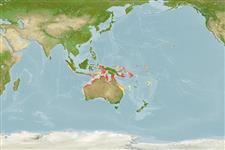
Indo-West Pacific: northern Australia.
Dimensione / Peso / Età
Maturità: Lm ? range ? - ? cm
Max length : 50.0 cm TL maschio/sesso non determinato; (Ref. 36661)
Breve descrizione
Chiavi di identificazione | Morfologia | Morfometria
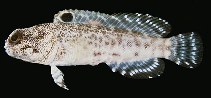
Spine dorsali (totale) : 10 - 11; Raggi dorsali molli (totale) : 17 - 18; Spine anali: 2; Raggi anali molli: 14 - 15; Vertebre: 30 - 32. This species is distinguished by the following characters: with a rigid upper jaw lacking flexible lamina posteriorly, in adults extending about 0.7-1.2 eye diameters behind posterior margin of orbit; infraorbitals are relatively slender and tubular, the third infraorbital with small sensory canal opening and slender suborbital shelf; D X-XI,17-18, rarely X,18; vertebrae typically 12 + 18 or 19; body with two separate lateral lines, with the ventral one irregularly developed along lower side in region of anal-fin origin, often with one or more branches on belly; head covered with close-set, tiny, brown spots; pelvic and caudal fins usually strongly barred; anterior naris palmate (Ref. 128653).
Cross section: compressed.
Found in shallow reefs, in sand or rubble areas. Mouthbrooders (Ref. 240).
Ciclo vitale e comportamento di accoppiamento
Maturità | Riproduzione | Deposizione | Uova | Fecondità | Larve
Employ mouthbrooding to care for their young (Ref. 240).
Smith-Vaniz, W.F., 2023. Review of Indo-West Pacific jawfishes (Opistognathus: Opistognathidae), with descriptions of 18 new species. Zootaxa 5252(1):1-180. (Ref. 128653)
Stato della Lista Rossa IUCN (Ref. 130435: Version 2025-2 (Global))
Minaccia per l'uomo
Harmless
Usi umani
Strumenti
Rapporti speciali
Scarica XML
Fonti Internet
Stime basate su modelli
Temperatura preferita (Fonte Biblio.
123201): 25 - 29.2, mean 28 °C (based on 518 cells).
Indice di diversità filogenetica (Fonte Biblio.
82804): PD
50 = 0.5000 [Uniqueness, from 0.5 = low to 2.0 = high].
Bayesian length-weight: a=0.00389 (0.00180 - 0.00842), b=3.12 (2.94 - 3.30), in cm total length, based on all LWR estimates for this body shape (Ref.
93245).
Livello trofico (Fonte Biblio.
69278): 3.8 ±0.6 se; based on size and trophs of closest relatives
Vulnerabilità della pesca (Ref.
59153): Moderate vulnerability (40 of 100).
🛈
Nutrienti (Ref.
124155): Calcium = 52.9 [29.8, 78.5] mg/100g; Iron = 0.587 [0.378, 0.956] mg/100g; Protein = 18.7 [17.7, 19.6] %; Omega3 = 0.0846 [, ] g/100g; Selenium = 49.9 [27.3, 88.1] μg/100g; VitaminA = 48.8 [17.9, 129.8] μg/100g; Zinc = 1.28 [0.92, 1.75] mg/100g (wet weight);