>
Scombriformes (Mackerels) >
Trichiuridae (Cutlassfishes) > Aphanopodinae
Etymology: Aphanopus: Greek, aphanes = hidden + Greek, pous = foot (Ref. 45335); arigato: From the Japanese arigato meaning thank you, expressing the author's gratitude to his Japanese hosts during a visit to the scientific instituitions of Japan in October-December 1992.
Environnement : milieu / zone climatique / profondeur / gamme de distribution
Écologie
marin benthopélagique; profondeur 0 - 1350 m (Ref. 50610). Deep-water
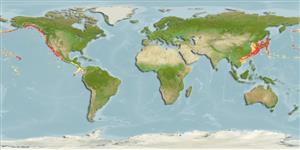
Western Pacific: Japan, Kuril Islands, NW Ridge (Kinmei Seamount). Eastern Pacific: Canada and the USA.
Taille / Poids / Âge
Maturité: Lm ? range ? - ? cm
Max length : 72.0 cm SL mâle / non sexé; (Ref. 41692)
Description synthétique
Clés d'identification | Morphologie | Morphométrie
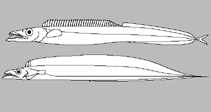
Épines dorsales (Total) : 39 - 43; Rayons mous dorsaux (Total) : 54 - 58; Épines anales: 2; Rayons mous anaux: 47 - 50; Vertèbres: 103 - 105. Distance from snout to anus 1.8-1.9 times in SL; eye diameter 5.6-6.5; upper jaw 2.15-2.30 times in HL (Ref. 41692).
Body shape (shape guide): eel-like.
Juveniles mesopelagic at 146-190 m at night, 300-1100 m during day; adults benthopelagic (Ref. 58302).
Cycle de vie et comportement reproducteur
Maturité | Reproduction | Frai | Œufs | Fécondité | Larves
Parin, N.V., 1995. Three new species and new records of cutlass fishes of the genus Aphanopus (Trichiuridae). J. Ichthyol. 35(2):128-138. (Ref. 41692)
Statut dans la liste rouge de l'IUCN (Ref. 130435: Version 2025-2 (Global))
Menace pour l'homme
Harmless
Utilisations par l'homme
Outils
Articles particuliers
Télécharger en XML
Sources Internet
Estimations basées sur des modèles
Température préférée (Réf.
123201): 0.8 - 18.5, mean 6.8 °C (based on 262 cells).
Indice de diversité phylogénétique (Réf.
82804): PD
50 = 0.5078 [Uniqueness, from 0.5 = low to 2.0 = high].
Bayesian length-weight: a=0.00046 (0.00020 - 0.00105), b=3.12 (2.92 - 3.32), in cm total length, based on LWR estimates for this (Sub)family-body shape (Ref.
93245).
Niveau trophique (Réf.
69278): 4.1 ±0.7 se; based on size and trophs of closest relatives
Résilience (Réf.
120179): Faible, temps minimum de doublement de population : 4,5 à 14 années (Assuming tmax>10).
Vulnérabilité de la pêche (Ref.
59153): High vulnerability (55 of 100).
🛈