>
Ovalentaria/misc (Various families in series Ovalentaria) >
Pseudochromidae (Dottybacks) > Congrogadinae
Etymology: Congrogadus: Latin, conger = conger + Latin, gadus = a fish, perhaps cod (Ref. 45335); winterbottomi: Named in honor of Rick Winterbottom, in recognition of his important contributions to the systematics and biogeography of congrogadines and other fishes, and in appreciation of his support and encouragement (Ref. 42960).
Eponymy: Dr Richard ‘Rick’ Winterbottom (d: 1944) is an evolutionary biologist and ichthyologist who was born in Zambia. [...] (Ref. 128868), visit book page.
More on authors: Gill, Mooi & Hutchins.
Ambiente: milieu / zona climatica / distribuzione batimetrica / gamma di distribuzione
Ecologia
marino demersale; distribuzione batimetrica 0 - 1 m (Ref. 58018). Subtropical; 22°S - 21°S, 115°E - 116°E (Ref. 51685)
Eastern Indian Ocean: a very restricted distribution in Western Australia (21°29'S), from the Exmouth Gulf northwards to the Onslow region (Ref. 51685).
Dimensione / Peso / Età
Maturità: Lm ? range ? - ? cm
Max length : 11.9 cm SL maschio/sesso non determinato; (Ref. 42960)
Breve descrizione
Chiavi di identificazione | Morfologia | Morfometria
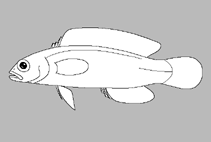
Spine dorsali (totale) : 1; Raggi dorsali molli (totale) : 57 - 61; Spine anali: 0; Raggi anali molli: 47 - 50; Vertebre: 63 - 65. Dorsal fin rays usually I,59 or I,60; anal fin rays usually 48 or 49; dark spot on operculum, none on shoulder; gill membranes fused ventrally with posterior margin free from isthmus; lateral line single, short anterodorsal section; teeth in outer row of dentary and premaxilla 14-21; and cheek with short dark bar extending from posteroventral edge of eye towards lower tip of preopercle (Ref. 42960).
Body shape (shape guide): eel-like.
Adults are found in rocky mud pools (Ref. 42960), in limestone reefs, with Sargassum and mainly sandy or muddy bottoms (very little coral) in less than 1 m depth (Ref. 51685).
Ciclo vitale e comportamento di accoppiamento
Maturità | Riproduzione | Deposizione | Uova | Fecondità | Larve
Gill, A.C., R.D. Mooi and J.B. Hutchins, 2000. Description of a new subgenus and species of the fish genus Congrogadus Günther from western Australia (Perciformes: Pseudochromidae). Rec. Western Aust. Mus. 20:69-79. (Ref. 42960)
Stato della Lista Rossa IUCN (Ref. 130435: Version 2025-2 (Global))
Minaccia per l'uomo
Harmless
Usi umani
Strumenti
Rapporti speciali
Scarica XML
Fonti Internet
Stime basate su modelli
Indice di diversità filogenetica (Fonte Biblio.
82804): PD
50 = 0.5156 [Uniqueness, from 0.5 = low to 2.0 = high].
Bayesian length-weight: a=0.00102 (0.00046 - 0.00225), b=3.06 (2.88 - 3.24), in cm total length, based on all LWR estimates for this body shape (Ref.
93245).
Livello trofico (Fonte Biblio.
69278): 3.5 ±0.53 se; based on food items.
Resilienza (Fonte Biblio.
120179): Alto, tempo minimo di raddoppiamento della popolazione meno di 15 mesi (Preliminary K or Fecundity.).
Vulnerabilità della pesca (Ref.
59153): Low vulnerability (10 of 100).
🛈