Elasmobranchii (hajar och rockor) (sharks and rays) >
Orectolobiformes (Carpet sharks) >
Hemiscylliidae (Bamboo sharks)
Etymology: Chiloscyllium: cheilos (Gr.), lip, referring to membranous and broad lower lip, presumably of C. plagiosum (proposed without a species); skylion, Greek for dogfish or small shark (See ETYFish); indicum: -icus (Gr.), belonging to: Indian Ocean, type locality (See ETYFish).
More on author: Gmelin.
Miljö: miljö / Klimatzon / djupintervall / distributionsområde
Ekologi
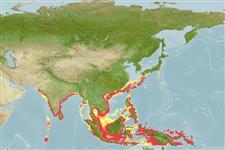
marina; sötvatten; brackvatten bottenlevande; havsvandrande (Ref. 51243); djupintervall 0 - 90 m (Ref. 106604). Tropical; 40°N - 10°S, 65°E - 160°E
Indo-West Pacific: India, Sri Lanka, to about Bangladesh; possibly Arabian Sea, and around Thailand and Indonesia (Sumatra). Records from Solomon Islands and north to China and Japan are different species, possibly Chiloscyllium plagiosum.
Längd vid första mognad / Storlek / Vikt / Ålder
Könsmognad: Lm ?, range 43 - ? cm
Max length : 65.0 cm TL hane/ej könsbestämd; (Ref. 247)
Taggstrålar i ryggfenan (totalt) : 0; Taggstrålar i analfenan: 0. Genus: Nostrils subterminal on snout; pre-oral snout long, mouth closer to eyes than snout tip; eyes and supraorbital ridges hardly elevated; no black hood on head or large spot or spots on sides of body above pectoral fins (Ref. 43278). Caudal fin with a pronounced subterminal notch but without a ventral lobe (Ref. 13575).
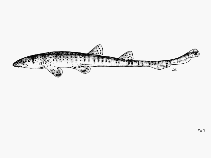
Species: Light brown above, cream below, with numerous dark spots on body, tail, and fins, these often forming indistinct vertical bars and saddles (Ref. 31575). Dermal ridge on middle of back and two low lateral ridges (Ref. 4832).
Body shape (shape guide): elongated.
A common, but little-known inshore sluggish bottom shark (Ref. 13575) found on sandy and muddy bottoms of coastal waters, bays and inlets and rocky and coral reefs. Probably mainly feeds on bottom-dwelling invertebrates (Ref. 13575), also small fishes. Oviparous (Ref. 50449). Utilized for human consumption (Ref. 247). Possibly may occur in fresh water in the lower reaches of the Perak River in peninsular Malaysia (Ref. 43278).
Livscykel och parningsbeteende
Könsmognad | Reproduktion | Lek | Ägg | Fekunditet | Larver
Oviparous, deposits eggs in small, oval egg cases on the bottom (Ref. 247). Paired eggs are laid. Embryos feed solely on yolk (Ref. 50449). Distinct pairing with embrace (Ref. 205).
Compagno, L.J.V., 1984. FAO Species Catalogue. Vol. 4. Sharks of the world. An annotated and illustrated catalogue of shark species known to date. Part 1 - Hexanchiformes to Lamniformes. FAO Fish. Synop. 125(4/1):1-249. Rome, FAO. (Ref. 247)
Status på IUCN:s rödlista (Ref. 130435: Version 2025-2 (Global))
Hot mot människor
Harmless
Mänskliga användningsområden
Fiskeri: kommersiell
Verktyg
Särskilda rapporter
Ladda ner XML
Internet-källor
Uppskattningar baserade på modeller
Önskad temperatur (Ref.
123201): 25.8 - 29.3, mean 28.8 °C (based on 1477 cells).
Index för fylogenetisk mångfald (Ref.
82804): PD
50 = 0.5039 [Uniqueness, from 0.5 = low to 2.0 = high].
Bayesian length-weight: a=0.00380 (0.00207 - 0.00699), b=3.14 (2.97 - 3.31), in cm total length, based on LWR estimates for this species & (Sub)family-body (Ref.
93245).
Trofisk nivå (Ref.
69278): 4.0 ±0.60 se; based on food items.
Resiliens (Ref.
120179): Låg, lägsta populationsfördubblingstid 4,5-14 år (Fec assumed to be <100).
Sårbarhet i fisket (Ref.
59153): Moderate to high vulnerability (46 of 100).
🛈