Elasmobranquios (tiburones y rayas) (sharks and rays) >
Carcharhiniformes (Ground sharks) >
Hemigaleidae (Weasel sharks)
Etymology: Chaenogaleus: chaeno-, from chaino (Gr.), gape, referring to “rictus as long as wide”; galeos, a small shark or dogfish per Aristotle (sometimes translated as weasel, hence the name Weasel Sharks, possibly referring to the pointed snouts, swift movements and/or rapacious feeding behavior of smaller predatory sharks1), but in this case probably an allusion to Hemigaleus, original genus of C. macrostoma (See ETYFish); macrostoma: macro-, from makros (Gr.), large or long; stoma (Gr.), mouth, referring to long, greatly arched mouth compared with Hemigaleus microstoma, its presumed congener at the time (See ETYFish).
More on author: Bleeker.
Entorno: milieu / zona climática / rango de profundidad / gama de distribución
Ecología
marino demersal; rango de profundidad ? - 59 m (Ref. 244). Tropical; 30°N - 10°S
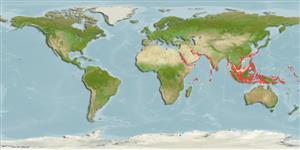
Indo-West Pacific: Persian Gulf (Ref. 13567), Pakistan, India, Sri Lanka, Singapore, Thailand, Viet Nam, China, Taiwan, Java and Sulawesi in Indonesia. This name has been used indiscriminately for the three species of hemigaleids in Indo-Pakistani waters other than Hemipristis elongatus.
Longitud en la primera madurez / Tamaño / Peso / Edad
Madurez: Lm 82.5, range 68 - 97 cm
Max length : 100.0 cm TL macho / no sexado; (Ref. 244)
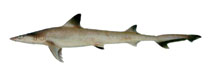
Espinas dorsales (total) : 0; Espinas anales: 0. Bronzy-grey above, white below when fresh, fading to greyish or greyish brown in preservation, dorsal fins often with dusky or black tips (Ref. 13567).
Body shape (shape guide): elongated.
A common inshore and offshore shark found on the continental and insular shelves (Ref. 13567). Probably feeds on small fishes, cephalopods, and crustaceans (Ref. 244). Viviparous (Ref. 50449). Caught irregularly by inshore gillnet fisheries and occasionally by small-scale longlining (Ref.58048). Probably taken by artisanal fisheries wherever it occurs (Ref. 13567). Utilized fresh for human consumption and by-products processed into fishmeal (Ref. 244).
Viviparous (with a yolk-sac placenta), with 4 young in a litter (Ref. 244). Size at birth at least 20 cm (Ref. 244). Distinct pairing with embrace (Ref. 205).
Compagno, L.J.V., 1984. FAO Species Catalogue. Vol. 4. Sharks of the world. An annotated and illustrated catalogue of shark species known to date. Part 2 - Carcharhiniformes. FAO Fish. Synop. 125(4/2):251-655. Rome: FAO. (Ref. 244)
Situación en la Lista Roja de la UICN (Ref. 130435: Version 2025-2 (Global))
Amenaza para el ser humano
Usos humanos
Pesquerías: escaso valor comercial
Herramientas
Informes especiales
Descargar XML
Fuentes de Internet
Estimaciones basadas en modelos
Temperatura preferida (Referencia
123201): 25 - 29.3, mean 28.4 °C (based on 1082 cells).
Índice de diversidad filogenética (Referencia
82804): PD
50 = 1.0039 [Uniqueness, from 0.5 = low to 2.0 = high].
Bayesian length-weight: a=0.00302 (0.00216 - 0.00423), b=3.04 (2.95 - 3.13), in cm total length, based on LWR estimates for this species (Ref.
93245).
Nivel trófico (Referencia
69278): 4.2 ±0.57 se; based on food items.
Resiliencia (Referencia
120179): Muy bajo, población duplicada en un tiempo mínimo superior a 14 años (Fec=4).
Vulnerabilidad pesquera (Ref.
59153): High vulnerability (60 of 100).
🛈