Elasmobranchii (Haie und Rochen) (sharks and rays) >
Lamniformes (Mackerel sharks) >
Alopiidae (Thresher sharks)
Etymology: Alopias: From alopex, Greek for fox, referring to the ancient vernacular “fox shark,” from its supposed cunning (ancients believed that when it took a bait, it swallowed the hook until it got to the cord, which it bit off and so escaped) (See ETYFish); pelagicus: Pelagic, (from pelagos, Greek for sea), referring to its “living in the upper layer of the sea,” in contrast to A. profundus [=superciliosus], which Nakamura believed dwelled on the “sea-bottom”) (See ETYFish).
Umwelt: Milieu / Klimazone / Tiefenbereich / Verbreitungsgebiet
Ökologie
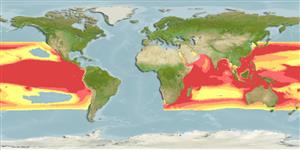
seewasser pelagic-oceanic; ozeanodrom (Ref. 87829); tiefenbereich 0 - 300 m (Ref. 106604), usually 0 - 150 m (Ref. 55167). Tropical; 40°N - 42°S, 16°E - 70°W (Ref. 54277)
Circumglobal. Indo-Pacific: Red Sea, Arabian Sea, Maldives (Ref. 30829), Somalia, South Africa, Western Australia, China, Taiwan, Japan, New Caledonia, Hawaiian Islands and Tahiti. Eastern Pacific: Gulf of California and the Galapagos. Reliable records lacking partly due to its confusion with Alopias vulpinus.
Länge bei der ersten Reifung / Größe / Gewicht / Alter
Geschlechtsreife: Lm 287.0, range 260 - 292 cm
Max length : 428 cm TL Männchen/unbestimmt; (Ref. 106604); 383.0 cm TL (female); common length : 276 cm TL Männchen/unbestimmt; (Ref. ); max. veröff. Alter: 29 Jahre (Ref. 48844)
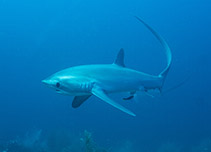
Rückenflossenstacheln (insgesamt) : 0; Afterflossenstacheln: 0. A small thresher with moderately large eyes, a broadly convex forehead, a very narrow caudal tip, and straight, broad-tipped pectoral fins (Ref. 5578). Upper lobe of caudal fin very long and strap-like, almost equal to length of rest of shark; lower lobe short but strong; terminal lobe very small (Ref. 13570). Dark blue on back and sides, underside white; no white patch over pectoral fin bases (Ref. 5578).
Body shape (shape guide): fusiform / normal.
Primarily an oceanic species but sometimes close inshore (Ref. 247, 5578, 58302); neritic to oceanic, 0-152 m (Ref. 11230). Epipelagic (Ref. 58302). Mesopelagic in the tropics; may enter atoll lagoons (Ref. 37816). Stuns its prey with its tail, presumably feeding on small fishes and cephalopods (Ref. 6871). Ovoviviparous, embryos feeding on yolk sac and other ova produced by the mother (Ref. 43278, 50449). Sometimes caught by ski-boat anglers (Ref. 5578). Utilized for human consumption, liver oil for vitamin extraction, hides for leather, and fins for shark-fin soup (Ref. 13570). A very common catch in the tuna and shark longline, and tuna drift net fisheries (Ref.58048). Maximum and common size of males estimated from discussion in Ref. 247. Adult females may reach at least 330 cm TL (Ref. 47613).
Exhibit ovoviparity (aplacental viviparity), with embryos feeding on other ova produced by the mother (oophagy) after the yolk sac is absorbed (Ref. 50449, 42326). Usually with at least two young (Ref. 6871). Size at birth about 100 cm (Ref. 6871); 130-160 cm TL (Ref. 58048). Distinct pairing with embrace (Ref. 205).
Compagno, L.J.V., 1984. FAO Species Catalogue. Vol. 4. Sharks of the world. An annotated and illustrated catalogue of shark species known to date. Part 1 - Hexanchiformes to Lamniformes. FAO Fish. Synop. 125(4/1):1-249. Rome, FAO. (Ref. 247)
IUCN Rote Liste Status (Ref. 130435: Version 2025-2 (Global))
Nutzung durch Menschen
Fischereien: kommerziell; Sportfisch: ja
Tools
Zusatzinformationen
Download XML
Internet Quellen
Schätzungen auf der Grundlage von Modellen
Bevorzugte Temperatur (Ref.
123201): 18.7 - 28.6, mean 26.7 °C (based on 2246 cells).
Phylogenetischer Diversitätsindex (Ref.
82804): PD
50 = 0.7500 [Uniqueness, from 0.5 = low to 2.0 = high].
Bayesian length-weight: a=0.01047 (0.00410 - 0.02677), b=2.94 (2.72 - 3.16), in cm total length, based on LWR estimates for this (Sub)family-body shape (Ref.
93245).
Trophische Ebene (Ref.
69278): 4.5 ±0.66 se; based on food items.
Widerstandsfähigkeit (Ref.
120179): sehr niedrig, Verdopplung der Population dauert mehr als 14 Jahre. (Fec=2; tm=7-9; tmax = 29).
Prior r = 0.40, 95% CL = 0.26 - 0.60, Based on 2 full stock assessments.
Anfälligkeit der Fischerei (Ref.
59153): High to very high vulnerability (73 of 100).
🛈
Nährstoffe (Ref.
124155): Calcium = 12.5 [3.6, 65.0] mg/100g; Iron = 0.765 [0.179, 2.248] mg/100g; Protein = 19.9 [17.5, 22.3] %; Omega3 = 0.237 [0.096, 0.582] g/100g; Selenium = 65.4 [16.1, 211.4] μg/100g; VitaminA = 9.66 [3.23, 29.16] μg/100g; Zinc = 0.469 [0.225, 0.893] mg/100g (wet weight);