>
Gadiformes (Cods) >
Macrouridae (Grenadiers or rattails)
Etymology: Coelorinchus: Greek, koilos = a hollow + Greek, rhyngchos = jaw (Ref. 45335); pardus: From the Greek pardus, the pard, leopard, in reference to its leopard-like spots.
More on authors: Iwamoto & Williams.
Ambiente: milieu / zona climatica / distribuzione batimetrica / gamma di distribuzione
Ecologia
marino benthopelagico; distribuzione batimetrica 107 - 187 m (Ref. 35909). Tropical
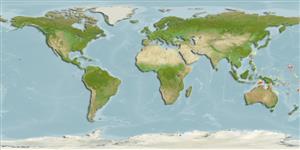
Western Central Pacific: confined to the Arafura Sea in the Northern Territory, Australia.
Dimensione / Peso / Età
Maturità: Lm ? range ? - ? cm
Max length : 30.0 cm TL maschio/sesso non determinato; (Ref. 35909)
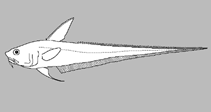
Spine dorsali (totale) : 2. Snout long, 43-49% of HL, anterolateral margin not completely supported by bone; characteristic scales overlap anterolaterally onto ventral snout surface; orbit diameter 22-25% of HL, 1.8-2.2 times into snout length; upper jaw 24-27% of HL; chin barbel short, about equal to length of first gill slit; subopercle lacking a prolonged narrow flap. Light organ extends from behind isthmus to front of anus. Underside of head naked; nasal fossa naked; body scales thin, spinules short, fine, aligned in close parallel rows. Conspicuous body markings consisting of blotches, spots and occasional ring on dorsum, becoming a narrow dorsal stripe to end of tail; belly between periproct and pelvic fin bases lacking melanophores; maxillary ramus immaculate (rarely with 2-3 melanophores). First dorsal fin with membrane between second spinous ray and first segmented ray black; anterior end of anal fin blackish distally. Pyloric caeca 8-11, usually 10-11; P i14-i15, rarely i16.
Body shape (shape guide): elongated.
Found on the continental shelf. Benthic (Ref. 75154).
Ciclo vitale e comportamento di accoppiamento
Maturità | Riproduzione | Deposizione | Uova | Fecondità | Larve
Iwamoto, T. and A. Williams, 1999. Grenadiers (Pisces, Gadiformes) from the continental slope of western and northwestern Australia. Proc. Calif. Acad. Sci. 51(3):105-243. (Ref. 35909)
Stato della Lista Rossa IUCN (Ref. 130435: Version 2025-2 (Global))
Minaccia per l'uomo
Harmless
Usi umani
Strumenti
Rapporti speciali
Scarica XML
Fonti Internet
Stime basate su modelli
Temperatura preferita (Fonte Biblio.
123201): 20.9 - 23.6, mean 22.1 °C (based on 7 cells).
Indice di diversità filogenetica (Fonte Biblio.
82804): PD
50 = 0.5000 [Uniqueness, from 0.5 = low to 2.0 = high].
Bayesian length-weight: a=0.00257 (0.00132 - 0.00501), b=3.19 (3.02 - 3.36), in cm total length, based on LWR estimates for this Genus-body shape (Ref.
93245).
Livello trofico (Fonte Biblio.
69278): 3.5 ±0.5 se; based on size and trophs of closest relatives
Resilienza (Fonte Biblio.
120179): Medio, tempo minimo di raddoppiamento della popolazione 1.4 - 4.4 anni (Preliminary K or Fecundity.).
Vulnerabilità della pesca (Ref.
59153): Low vulnerability (20 of 100).
🛈