>
Eupercaria/misc (Various families in series Eupercaria) >
Nemipteridae (Threadfin breams, Whiptail breams)
Etymology: Scolopsis: Name from the Greek masculine noun 'skolos' meaning 'thorn' and suffix '-opsis' (from Greek feminine n. 'opsis' meaning 'aspect', 'appearance') meaning ‘thorny appearance’ presumably referring to 'les dentelures de la préopercule, en ont aussi, et même d'épineuses, aux sous-orbitaires' mentioned by Cuvier (1814) in his designation of the genus. Name ending in -'opsis' are treated as feminine according to ICZN 1999: Article 30.1.2 (Ref. 130620).
More on author: Günther.
Lingkungan: lingkungan / zona iklim / kisaran kedalaman / jangkauan distribusi
Ekologi
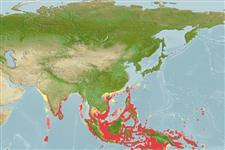
laut berasosiasi dengan karang; kisaran kedalaman 5 - 50 m (Ref. 9785), usually 15 - 50 m (Ref. 9710). Tropical; 27°N - 13°S, 65°E - 167°E (Ref. 3810)
Indo-West Pacific: Maldives and Sri Lanka to the Solomon Islands; Ryukyu Islands to Australia (eastern Queensland and Western Australia).
Ukuran / Berat / umur
Kematangan: Lm ? range ? - ? cm
Max length : 22.0 cm TL jantan/; (Ref. 90102); common length : 14.0 cm SL jantan/; (Ref. 3810)
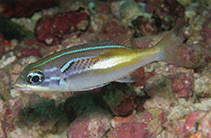
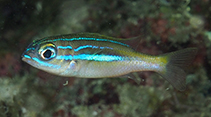
Duri punggung (Keseluruhan (total)) : 10; duri punggung lunak (Keseluruhan (total)) : 9; Duri dubur: 3; Sirip dubur lunak: 7. Head scales reaching forward to between level of anterior margin of eyes and posterior nostrils. Lower limb of preopercle scaly. Antrorse (forward-directed) suborbital spine present beneath eye. Pelvic fins moderately long, reaching to or almost to level of anus. Color: Upper body greyish-brown, silvery-white below. A pearly-blue streak from behind eye along dorsal fin base. An oblique, brown-edged pearly-blue bar above the pectoral base. An elongate white blotch below lateral line on posterior half of body, a yellowish tinge above this blotch. Snout dusky and a black blotch on opercle.
Body shape (shape guide): fusiform / normal; Cross section: oval.
Inhabits coastal waters around rocky-rubble and seaweed areas of coral reefs, outer slopes and lagoons. Usually in small groups but may be seen solitary (Ref. 48635, 90102). Feeds mainly on benthic crustaceans.
Siklus hidup dan perilaku kawin
Kematangan | Reproduksi, perkembang biakan | Pemijahan | telur-telur | Fekunditas | Larva
Russell, B.C., 1990. FAO Species Catalogue. Vol. 12. Nemipterid fishes of the world. (Threadfin breams, whiptail breams, monocle breams, dwarf monocle breams, and coral breams). Family Nemipteridae. An annotated and illustrated catalogue of nemipterid species known to date. FAO Fish. Synop. 125(12):149p. Rome: FAO. (Ref. 3810)
Status IUCN Red List (Ref. 130435: Version 2025-2 (Global))
ancaman kepada manusia
Harmless
penggunaan manusia
Perikanan: perikanan swasembada
Alat, peralatan
laporan khas
muat turun XML
Sumber internet
Estimasi berdasarkan model
Suhu yang disukai (Acuan
123201): 26.9 - 29, mean 28.2 °C (based on 908 cells).
Indeks keanekaragaman filogenetik (Acuan
82804): PD
50 = 0.5000 [Uniqueness, from 0.5 = low to 2.0 = high].
Bayesian length-weight: a=0.01202 (0.00654 - 0.02211), b=2.96 (2.81 - 3.11), in cm total length, based on LWR estimates for this species & Genus-body shape (Ref.
93245).
Tingkat Trofik (Acuan
69278): 3.4 ±0.43 se; based on food items.
Daya lenting (Acuan
120179): Tinggi, Waktu penggandaan populasi minimum kurang dari 15 bulan (Preliminary K or Fecundity.).
Kerentanan Penangkapan Ikan (Ref.
59153): Low vulnerability (12 of 100).
🛈
Nutrisi (Ref.
124155): Calcium = 69.1 [41.3, 140.0] mg/100g; Iron = 0.721 [0.357, 1.684] mg/100g; Protein = 18.9 [17.1, 20.6] %; Omega3 = 0.157 [0.095, 0.262] g/100g; Selenium = 29.5 [17.8, 53.2] μg/100g; VitaminA = 77.2 [21.9, 225.0] μg/100g; Zinc = 1.39 [0.96, 2.02] mg/100g (wet weight);