>
Lophiiformes (Anglerfishes) >
Himantolophidae (Footballfishes)
Etymology: Himantolophus: Greek, himas or himantos = leather strap, thong or leash (referring to the thick leathery illicium) + Greek, lopho or lophio = crest or tuft (referring to the baited illicium projecting from the head) (Ref. 86949); sagamius: Named for its type locality, Gulf of Sagami.
More on author: Tanaka.
Entorno: milieu / zona climática / rango de profundidad / gama de distribución
Ecología
marino batipelágico; rango de profundidad 613 - 1200 m (Ref. 82206). Deep-water
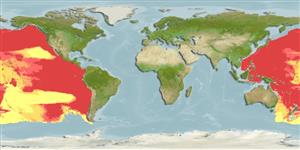
Pacific: Kuril-Kamchatka trough, coast of the Hokkaido and Honshu islands (Gulf of Sagami), and from California to Peru..
Tamaño / Peso / Edad
Madurez: Lm ? range ? - ? cm
Max length : 20.0 cm SL macho / no sexado; (Ref. 82206)
Descripción breve
Claves de identificación | Morfología | Morfometría
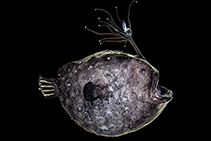
Radios blandos dorsales (total) : 5; Radios blandos anales: 4. Distinguishing characteristics of adult female: length of anterior escal appendage 11-38% SL; distal escal appendage 6.2-11% SL; blunt distal lobes of esca; posterior escal appendage 12-41% SL, simple or with bifid tip; posterolateral appendages 2-4 pairs, situated on and below base of escal bulb, length of distal and longest pair 30-45% SL (Ref. 86949).
Meso- and bathypelagic (Ref. 58302).
Ciclo vital y comportamiento de apareamiento
Madurez | Reproducción | Puesta | Huevos | Fecundidad | Larva
Pietsch, T.W., 1999. Himantolophidae. Footballfishes (deep-sea anglerfishes). p. 2029. In K.E. Carpenter and V.H. Niem (eds.) FAO species identification guide for fishery purposes. The living marine resources of the WCP. Vol. 3. Batoid fishes, chimaeras and bony fishes part 1 (Elopidae to Linophrynidae). FAO, Rome. (Ref. 12944)
Situación en la Lista Roja de la UICN (Ref. 130435: Version 2025-2 (Global))
Amenaza para el ser humano
Harmless
Usos humanos
Herramientas
Informes especiales
Descargar XML
Fuentes de Internet
Estimaciones basadas en modelos
Temperatura preferida (Referencia
123201): 4.3 - 7.8, mean 5.7 °C (based on 325 cells).
Índice de diversidad filogenética (Referencia
82804): PD
50 = 0.5000 [Uniqueness, from 0.5 = low to 2.0 = high].
Bayesian length-weight: a=0.01995 (0.00906 - 0.04395), b=3.01 (2.83 - 3.19), in cm total length, based on all LWR estimates for this body shape (Ref.
93245).
Nivel trófico (Referencia
69278): 4.5 ±0.37 se; based on food items.
Vulnerabilidad pesquera (Ref.
59153): Low vulnerability (14 of 100).
🛈