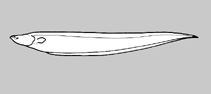
Klassifizierung / Names
Namen | Synonyme | Catalog of Fishes(Gattung, Arten) | ITIS | CoL | WoRMS | Cloffa
>
Gymnotiformes (Knifefishes) >
Gymnotidae (Naked-back knifefishes) > Gymnotinae
Etymology: Gymnotus: Greek, gymnos = naked (Ref. 45335); jonasi: Named in honor of Jonas Alves de Oliveira, a Brazilian naturalist working for the Mamirauá Sustainable Development Reserve (Ref. 41292).
Eponymy: Jonas Alves de Oliveira is a naturalist and technician at Mamirauá Sustainable Development Reserve, Amazonas, Brazil. He co-wrote: Chromosomal diversity in three species of electric fish (Apteronotidae, Gymnotiformes) from the Amazon Basin (2014). (Ref. 128868), visit book page.
Umwelt: Milieu / Klimazone / Tiefenbereich / Verbreitungsgebiet
Ökologie
; süßwasser benthopelagisch. Subtropical
South America: Amazon River basin, Brazil.
Größe / Gewicht / Alter
Geschlechtsreife: Lm ? range ? - ? cm
Max length : 13.5 cm TL Männchen/unbestimmt; (Ref. 41292); max. veröff. Gewicht: 4.00 g (Ref. 41292)
Kurzbeschreibung
Bestimmungsschlüssel | Morphologie | Morphometrie
Electric organs present.
Facultative air-breathing in the genus (Ref. 126274); Recorded from root mass of floating meadows in the whitewater floodplains of the Tefé region where it is common although patchy in distribution. Adults both breed and forage in the meadows and are never encountered in other floodplain habitats such as flooded forests. Both juveniles and adults feed on small aquatic animals, especially chironomid larvae (Ref. 41292).
Lebenszyklus und Paarungsverhalten
Geschlechtsreife | Fortpflanzung | Ablaichen | Eier | Fruchtbarkeit | Larven
Albert, J.S. and W.G.R. Crampton, 2001. Five new species of Gymnotus (Teleostei: Gymnotiformes) from an upper Amazon floodplain, with descriptions of electric organ discharges and ecology. Ichthyol. Explor. Freshwat. 12(3):241-266. (Ref. 41292)
IUCN Rote Liste Status (Ref. 130435: Version 2025-2 (Global))
Bedrohung für Menschen
Harmless
Nutzung durch Menschen
Tools
Zusatzinformationen
Download XML
Internet Quellen
Schätzungen auf der Grundlage von Modellen
Phylogenetischer Diversitätsindex (Ref.
82804): PD
50 = 0.5000 [Uniqueness, from 0.5 = low to 2.0 = high].
Bayesian length-weight: a=0.00437 (0.00209 - 0.00911), b=2.98 (2.79 - 3.17), in cm total length, based on LWR estimates for this (Sub)family-body shape (Ref.
93245).
Trophische Ebene (Ref.
69278): 2.5 ±0.50 se; based on food items.
Widerstandsfähigkeit (Ref.
120179): hoch, Verdopplung der Population dauert weniger als 15 Monate. (Preliminary K or Fecundity.).
Anfälligkeit der Fischerei (Ref.
59153): Low vulnerability (10 of 100).
🛈