>
Eupercaria/misc (Various families in series Eupercaria) >
Nemipteridae (Threadfin breams, Whiptail breams)
Etymology: Scaevius: Latin, scaeva = the wrong way, clumsy.
Eponymy: Baron Pierre Bernard Milius (1773–1829) was a French naval officer, naturalist and civil servant who took part in an exploratory voyage (1804) of the Mascarene Islands, Indian Ocean, under Nicolas Baudin, during which he became friends with Bory. [...] (Ref. 128868), visit book page.
Ambiente: milieu / zona climatica / distribuzione batimetrica / gamma di distribuzione
Ecologia
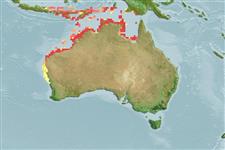
marino associati a barriera corallina; distribuzione batimetrica 1 - 20 m (Ref. 9785). Tropical; 7°S - 30°S, 109°E - 141°E (Ref. 3810)
Western Pacific: northwestern Australia from Gulf of Carpentaria to Abrolhos Islands. Also known from Papua New Guinea (Ref. 6192). This species has been commonly referred to as Scaevius nicanor Whitley, but Scaevius milii is the older name.
Dimensione / Peso / Età
Maturità: Lm ? range ? - ? cm
Max length : 20.0 cm SL maschio/sesso non determinato; (Ref. 3810); common length : 15.0 cm SL maschio/sesso non determinato; (Ref. 3810)
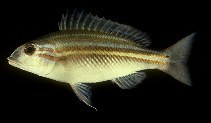
Spine dorsali (totale) : 10; Raggi dorsali molli (totale) : 9; Spine anali: 3; Raggi anali molli: 7. Scales on top of head not reaching to level of eyes. Snout, suborbital, interorbital, and temporal parts of head naked. Posterior margin of suborbital denticulate, a small spine in upper corner. 5 or 6 transverse rows of cheek scales. Preopercle serrate, opercle scaly. Lower limb of preopercle naked. Upper margin of opercle with a small, flat, rounded spine. Pectoral fins short, not reaching to level of anus. Pelvic fins long, reaching to level of anus. Color: Dark olive on top of head, back paler, ventral surface white. 2 blue stripes on snout, the first joining eyes through nostrils, the second across front of snout. 2 narrow blue lines below eye crossing suborbital.
Body shape (shape guide): fusiform / normal; Cross section: oval.
Abundant on shallow inshore reefs and adjacent sand or mud bottoms. Feeds on small fishes and benthic invertebrates. Unimportant as a food fish. No major fishery exists.
Ciclo vitale e comportamento di accoppiamento
Maturità | Riproduzione | Deposizione | Uova | Fecondità | Larve
Russell, B.C., 1990. FAO Species Catalogue. Vol. 12. Nemipterid fishes of the world. (Threadfin breams, whiptail breams, monocle breams, dwarf monocle breams, and coral breams). Family Nemipteridae. An annotated and illustrated catalogue of nemipterid species known to date. FAO Fish. Synop. 125(12):149p. Rome: FAO. (Ref. 3810)
Stato della Lista Rossa IUCN (Ref. 130435: Version 2025-2 (Global))
Minaccia per l'uomo
Harmless
Usi umani
Pesca: scarso interesse commerciale
Strumenti
Rapporti speciali
Scarica XML
Fonti Internet
Stime basate su modelli
Temperatura preferita (Fonte Biblio.
123201): 26.7 - 28.7, mean 28.3 °C (based on 282 cells).
Indice di diversità filogenetica (Fonte Biblio.
82804): PD
50 = 1.0000 [Uniqueness, from 0.5 = low to 2.0 = high].
Bayesian length-weight: a=0.01413 (0.00668 - 0.02988), b=2.97 (2.80 - 3.14), in cm total length, based on LWR estimates for this (Sub)family-body shape (Ref.
93245).
Livello trofico (Fonte Biblio.
69278): 4.0 ±0.63 se; based on food items.
Resilienza (Fonte Biblio.
120179): Alto, tempo minimo di raddoppiamento della popolazione meno di 15 mesi (Preliminary K or Fecundity.).
Vulnerabilità della pesca (Ref.
59153): Low vulnerability (14 of 100).
🛈
Nutrienti (Ref.
124155): Calcium = 70 [43, 149] mg/100g; Iron = 0.684 [0.321, 1.703] mg/100g; Protein = 19.2 [17.3, 20.9] %; Omega3 = 0.155 [0.090, 0.265] g/100g; Selenium = 22.6 [12.4, 42.8] μg/100g; VitaminA = 100 [27, 309] μg/100g; Zinc = 1.31 [0.88, 1.93] mg/100g (wet weight);