>
Anguilliformes (Eels and morays) >
Nettastomatidae (Duckbill eels)
Etymology: Facciolella: Latin, diminutive of falx, falcis = sickle (Ref. 45335).
Eponymy: Dr Luigi Facciolà (1851–1943) was an Italian physician and ichthyologist who was the first to recognise and describe the Witch-Eel genus (1911) but in doing so used a preoccupied name (Nettastomella). [...] (Ref. 128868), visit book page.
More on author: Gilbert.
Entorno: milieu / zona climática / rango de profundidad / gama de distribución
Ecología
marino batipelágico; rango de profundidad 64 - 1000 m (Ref. 96339). Deep-water
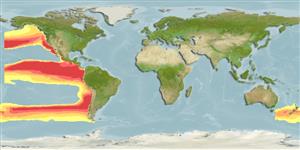
Eastern Central Pacific: Point Conception, California, USA to Panama, and Guadalupe and Galapagos Islands.
Tamaño / Peso / Edad
Madurez: Lm ? range ? - ? cm
Max length : 90.0 cm TL macho / no sexado; (Ref. 28023)
Descripción breve
Claves de identificación | Morfología | Morfometría
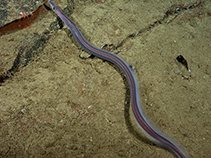
Color uniformly brown.
Body shape (shape guide): eel-like.
Feeds on small deep-sea crustaceans (Ref. 28023). Caught well offshore in pelagic waters to depths of several hundred meters (Ref. 28023).
Ciclo vital y comportamiento de apareamiento
Madurez | Reproducción | Puesta | Huevos | Fecundidad | Larva
Grove, J.S. and R.J. Lavenberg, 1997. The fishes of the Galápagos Islands. Stanford University Press, Stanford, 863 p. (Ref. 28023)
Situación en la Lista Roja de la UICN (Ref. 130435: Version 2025-2 (Global))
Amenaza para el ser humano
Harmless
Usos humanos
Pesquerías: sin interés
Herramientas
Informes especiales
Descargar XML
Fuentes de Internet
Estimaciones basadas en modelos
Temperatura preferida (Referencia
123201): 7.1 - 13.4, mean 9.6 °C (based on 59 cells).
Índice de diversidad filogenética (Referencia
82804): PD
50 = 0.5078 [Uniqueness, from 0.5 = low to 2.0 = high].
Bayesian length-weight: a=0.00087 (0.00035 - 0.00219), b=2.98 (2.76 - 3.20), in cm total length, based on LWR estimates for this (Sub)family-body shape (Ref.
93245).
Nivel trófico (Referencia
69278): 3.1 ±0.30 se; based on food items.
Resiliencia (Referencia
120179): Medio, población duplicada en un tiempo mínimo de 1.4-4.4 años (tm=4).
Vulnerabilidad pesquera (Ref.
59153): High vulnerability (56 of 100).
🛈