>
Anguilliformes (Eels and morays) >
Nettastomatidae (Duckbill eels)
Etymology: Facciolella: Latin, diminutive of falx, falcis = sickle (Ref. 45335); karrerae: Named in honor of Dr. Christine Karrer, Hamburg, in recognition of her contributions to the knowledge of Anguilliformes of the western Indian Ocean and her studies on deep-sea fishes of the Red Sea of the Senckenberg-Museum.
Eponymy: Dr Luigi Facciolà (1851–1943) was an Italian physician and ichthyologist who was the first to recognise and describe the Witch-Eel genus (1911) but in doing so used a preoccupied name (Nettastomella). [...] Dr Christine Karrer is a German biologist and ichthyologist at the Zoologisches Museum der Universität Hamburg. [...] (Ref. 128868), visit book page.
Entorno: milieu / zona climática / rango de profundidad / gama de distribución
Ecología
marino batidemersal; rango de profundidad 700 - 2000 m (Ref. 40802). Deep-water
Western Indian Ocean: Red Sea.
Tamaño / Peso / Edad
Madurez: Lm ? range ? - ? cm
Max length : 36.1 cm TL macho / no sexado; (Ref. 40802)
Descripción breve
Claves de identificación | Morfología | Morfometría
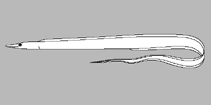
Espinas dorsales (total) : 0; Radios blandos dorsales (total) : 290; Espinas anales: 0; Radios blandos anales: 235; Vértebra: 166 - 184. Very light, whitish coloration of head, body and fins. Preanal pores 51-52.
Body shape (shape guide): eel-like.
Probably inhabiting holes found on soft sea-bottom.
Ciclo vital y comportamiento de apareamiento
Madurez | Reproducción | Puesta | Huevos | Fecundidad | Larva
Klausewitz, W., 1995. Deep water and deep-sea fishes of the Red Sea. XIX. Description of a new species of the deep-sea eel genus Facciolella (Pisces: Osteichthyes: Anguilliformes: Nettastomatidae). Senckenbergiana marit. 26(1/2):45-50. (Ref. 40802)
Situación en la Lista Roja de la UICN (Ref. 130435: Version 2025-2 (Global))
Amenaza para el ser humano
Harmless
Usos humanos
Herramientas
Informes especiales
Descargar XML
Fuentes de Internet
Estimaciones basadas en modelos
Temperatura preferida (Referencia
123201): 21.7 - 21.8, mean 21.7 °C (based on 11 cells).
Índice de diversidad filogenética (Referencia
82804): PD
50 = 0.5078 [Uniqueness, from 0.5 = low to 2.0 = high].
Bayesian length-weight: a=0.00087 (0.00035 - 0.00219), b=2.98 (2.76 - 3.20), in cm total length, based on LWR estimates for this (Sub)family-body shape (Ref.
93245).
Nivel trófico (Referencia
69278): 3.3 ±0.4 se; based on size and trophs of closest relatives
Resiliencia (Referencia
120179): Bajo, población duplicada en un tiempo mínimo de 4.5-14 años (Assuming tmax>10).
Vulnerabilidad pesquera (Ref.
59153): Low to moderate vulnerability (26 of 100).
🛈