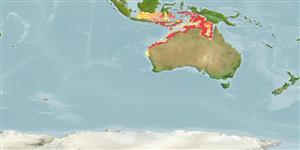
Ambiente: milieu / zona climatica / distribuzione batimetrica / gamma di distribuzione
Ecologia
marino associati a barriera corallina; distribuzione batimetrica 5 - 50 m (Ref. 90102). Tropical; 3°S - 27°S, 109°E - 141°E (Ref. 3810)
Eastern Indian Ocean: Aru Islands (Indonesia) and northwest Australia. This species closely resembles Pentapodus setosus and Pentapodus paradiseus.
Dimensione / Peso / Età
Maturità: Lm ? range ? - ? cm
Max length : 27.0 cm TL maschio/sesso non determinato; (Ref. 9710); common length : 15.0 cm SL maschio/sesso non determinato; (Ref. 3810)
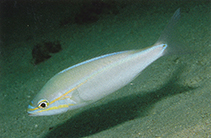
Spine dorsali (totale) : 10; Raggi dorsali molli (totale) : 9; Spine anali: 3; Raggi anali molli: 7. Head scales reaching forward to or almost to level of posterior nostrils. Suborbital naked. Lower limb of preopercle naked. Pelvic fins short, not reaching near level of anus. Upper and lower lobes of caudal fin pointed, more or less equal in length. Axillary scale present. Color: Upper body pale brownish, lower whitish. Presence of three bluish stripes across snout, first joining eyes behind nostrils, second in front of nostrils, third from eye to tip of snout. A yellow stripe from behind eye to upper base of pectoral fin and another running from middle of upper lip.
Body shape (shape guide): fusiform / normal; Cross section: oval.
Occurs close to reefs in offshore waters (Ref. 9785). Solitary or small groups (Ref. 90102).
Ciclo vitale e comportamento di accoppiamento
Maturità | Riproduzione | Deposizione | Uova | Fecondità | Larve
Russell, B.C., 1990. FAO Species Catalogue. Vol. 12. Nemipterid fishes of the world. (Threadfin breams, whiptail breams, monocle breams, dwarf monocle breams, and coral breams). Family Nemipteridae. An annotated and illustrated catalogue of nemipterid species known to date. FAO Fish. Synop. 125(12):149p. Rome: FAO. (Ref. 3810)
Stato della Lista Rossa IUCN (Ref. 130435: Version 2025-2 (Global))
Minaccia per l'uomo
Harmless
Usi umani
Pesca: pesca di sussistenza
Strumenti
Rapporti speciali
Scarica XML
Fonti Internet
Stime basate su modelli
Temperatura preferita (Fonte Biblio.
123201): 26.4 - 28.7, mean 27.9 °C (based on 182 cells).
Indice di diversità filogenetica (Fonte Biblio.
82804): PD
50 = 0.5001 [Uniqueness, from 0.5 = low to 2.0 = high].
Bayesian length-weight: a=0.01413 (0.00668 - 0.02988), b=2.97 (2.80 - 3.14), in cm total length, based on LWR estimates for this (Sub)family-body shape (Ref.
93245).
Livello trofico (Fonte Biblio.
69278): 3.6 ±0.5 se; based on size and trophs of closest relatives
Resilienza (Fonte Biblio.
120179): Alto, tempo minimo di raddoppiamento della popolazione meno di 15 mesi (Preliminary K or Fecundity.).
Vulnerabilità della pesca (Ref.
59153): Low vulnerability (17 of 100).
🛈
Nutrienti (Ref.
124155): Calcium = 57.7 [35.1, 116.1] mg/100g; Iron = 0.656 [0.321, 1.603] mg/100g; Protein = 19.1 [17.2, 20.8] %; Omega3 = 0.155 [0.093, 0.259] g/100g; Selenium = 29.7 [17.8, 53.1] μg/100g; VitaminA = 78.1 [22.6, 222.5] μg/100g; Zinc = 1.24 [0.86, 1.78] mg/100g (wet weight);