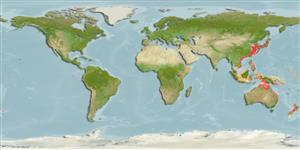
Lingkungan: lingkungan / zona iklim / kisaran kedalaman / jangkauan distribusi
Ekologi
laut bentopelagis; kisaran kedalaman 20 - 100 m (Ref. 76777), usually ? - 100 m (Ref. 76777). Tropical
Northwest Pacific: East Asian Shelf to the Sea of Japan and Pacific coast of southern Japan (except Ryukyu and Ogasawara Is.), including the western part of Taiwan and South China Sea; questionable from Singapore.
Ukuran / Berat / umur
Kematangan: Lm ? range ? - ? cm
Max length : 20.1 cm SL jantan/; (Ref. 76777)
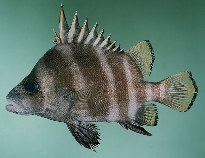
Duri punggung (Keseluruhan (total)) : 11; duri punggung lunak (Keseluruhan (total)) : 15 - 16; Duri dubur: 3; Sirip dubur lunak: 9 - 10. This species is distinguished by the following characters: lower lip fleshy with dense cluster of short papillae and barbels anteriorly, on and behind chin with 10 pores, 4 anterioriormost pairs hidden by papillae, slightly scaly posteriorly (posterior abdominal part of angular of lower jaws; maxilla with small scales; 5-7 alternating whitish and dark-brown bands on head and body, the first (often indistinct) from just before eye to posterior of lower jaw, the second somewhat oblique, becoming wider posteriorly, from nape to between eye and pelvic-fin base, third one from base of 2nd and 3rd dorsal-fin spines to just behind pelvic-fin base, the fourth from 7th and 8th dorsal-fin spine base to just before 1st anal-fin spine, the fifth from 2nd and 3rd dorsal-fin soft ray base to anterior of anal-fin soft ray base, the sixth on caudal peduncle, and the seventh (often indistinct) on caudal-fin base; soft rayed portions of dorsal and anal fins are somewhat rounded posteriorly and slightly angulated posteriorly, respectively, spinous dorsal-fin and anal fin (until first anal-fin ray) membranes are dense black; membrane of soft dorsal- anal- (especially in juveniles and young) and caudal-fins somewhat yellowish in fresh specimens, a dense black margin posteriorly, about same width as pupil diameter (juveniles) or half of this width (adults); pelvic-fin tip not reaching to base of 1st anal-fin spine when depressed; pored lateral-line scales 44-47 (rarely 43 or 48); procumbent spine-like process (exposed tip of first pterygiophore) at origin of dorsal fin usually covered by predorsal scales (Ref. 76777).
Body shape (shape guide): short and / or deep; Cross section: compressed.
Inhabits the sublittoral zone on sandy mud bottom (Ref. 11230). Most specimens were collected by bottom trawl in depths less than 100 m and smaller individuals (about 10.0 cm SL) by set nets at 20-50 m (Ref. 76777).
Iwatsuki, Y. and B.C. Russell, 2006. Revision of the genus Hapalogenys (Teleostei: Perciformes) with two new species from the Indo-West Pacific. Mem. Mus. Victoria 63(1):29-46. (Ref. 76777)
Status IUCN Red List (Ref. 130435: Version 2025-2 (Global))
ancaman kepada manusia
Harmless
penggunaan manusia
Perikanan: bycatch
Alat, peralatan
laporan khas
muat turun XML
Sumber internet
Estimasi berdasarkan model
Suhu yang disukai (Acuan
123201): 9.7 - 25, mean 19 °C (based on 249 cells).
Indeks keanekaragaman filogenetik (Acuan
82804): PD
50 = 0.5039 [Uniqueness, from 0.5 = low to 2.0 = high].
Bayesian length-weight: a=0.01905 (0.00861 - 0.04217), b=3.01 (2.81 - 3.21), in cm total length, based on LWR estimates for this (Sub)family-body shape (Ref.
93245).
Tingkat Trofik (Acuan
69278): 4.1 ±0.68 se; based on food items.
Daya lenting (Acuan
120179): Tinggi, Waktu penggandaan populasi minimum kurang dari 15 bulan (Preliminary K or Fecundity.).
Kerentanan Penangkapan Ikan (Ref.
59153): Low vulnerability (15 of 100).
🛈