Clasificación / Nombres
Nombres comunes | Sinónimos | Catalog of Fishes(Género, Especie) | ITIS | CoL | WoRMS | Cloffa
>
Cyprinodontiformes (Rivulines, killifishes and live bearers) >
Nothobranchiidae (African rivulines)
Etymology: Aphyosemion: Greek, aphye, -es, sardine, anchovy + Greek, semeion = mark, signal (Ref. 45335).
Entorno: milieu / zona climática / rango de profundidad / gama de distribución
Ecología
; agua dulce pelágico; pH range: 5.7 - ?; no migratorio; rango de profundidad 0 - ? m. Tropical; 23°C - ?
Africa: known from a limited number of localities between Libreville and Cap Esterias in north-western Gabon (Ref. 80395) and Owendo area south of Libreville in Gabon (Ref. 119374).
Tamaño / Peso / Edad
Madurez: Lm ? range ? - ? cm
Max length : 50.0 cm TL macho / no sexado; (Ref. 80395); 40.0 cm TL (female)
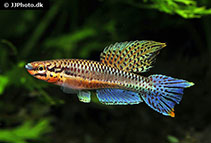
Espinas dorsales (total) : 0; Radios blandos dorsales (total) : 12 - 13; Espinas anales: 0; Radios blandos anales: 13 - 15; Vértebra: 24 - 25. Diagnosis: This is a fairly large species of the subgenus Chromaphyosemion, larger than all its congeners with the exception of Aphyosemion riggenbachi, which has the most forward placed dorsal fin (Ref. 41203). It is a strictly blue phenotype with a unique red marking on the sides of the body with the exception of the gill lids, with two conspicuous, mood-dependent dark longitudinal bands, with a red dotted dorsal fin, a flamed caudal fin and an "undrawn" anal fin, except for a thin red submarginal and white marginal band, with longer trapezoidal vertical unpaired fins and a caudal fin with short extracts in the males; the female also shows the alpha-shaped mark, with striking, dark bandages and an anal fin without spots, but without a dark mesh pattern around the scales on the sides of the body (Ref. 41203).
Body shape (shape guide): fusiform / normal; Cross section: oval.
This species is found in clear creeks under forest cover, usually over a sandy soil, in the coastal plain (Ref. 80395).
Ciclo vital y comportamiento de apareamiento
Madurez | Reproducción | Puesta | Huevos | Fecundidad | Larva
van der Zee, J.R., T. Woeltjes and R.H. Wildekamp, 2008. Aplocheilidae Bleeker, 1860. p. 80-240. In M.L.J. Stiassny, G.G. Teugels and C.D. Hopkins (eds.) Poissons d'eaux douces et saumâtres de basse Guinée, ouest de l'Afrique centrale/The fresh and brackish water fishes of Lower Guinea, west-central Africa. Volume 2. Collection Faune et Flore tropicales 42. Institut de Recherche pour le Développement, Paris, France, Muséum National d’Histoire Naturelle, Paris, France and Musée Royal de l’Afrique Centrale, Tervuren, Belgium. 603 p. (Ref. 80395)
Situación en la Lista Roja de la UICN (Ref. 130435: Version 2025-2 (Global))
Amenaza para el ser humano
Harmless
Usos humanos
Pesquerías: sin interés; Acuario: Potencial
Herramientas
Informes especiales
Descargar XML
Fuentes de Internet
Estimaciones basadas en modelos
Índice de diversidad filogenética (Referencia
82804): PD
50 = 0.5000 [Uniqueness, from 0.5 = low to 2.0 = high].
Bayesian length-weight: a=0.01096 (0.00461 - 0.02608), b=2.94 (2.74 - 3.14), in cm total length, based on LWR estimates for this (Sub)family-body shape (Ref.
93245).
Nivel trófico (Referencia
69278): 3.7 ±0.5 se; based on size and trophs of closest relatives
Vulnerabilidad pesquera (Ref.
59153): Moderate vulnerability (40 of 100).
🛈