Myxines (hagfishes) >
Myxiniformes (Hagfishes) >
Myxinidae (Hagfishes) > Eptatretinae
Etymology: Eptatretus: hepta (Gr.), seven; tretos (Gr.), perforated (i.e., with holes), referring to seven gill apertures on what would later be described as Homea banksii (=E. cirrhatus) [range within genus is 6-14 pairs of gill apertures] (See ETYFish); ancon: Named for the research vessel B/I Ancon, from which holotype was captured (See ETYFish).
Eponymy: This refers to the research vessel ‘Ancon’ from which the holotype was collected in the Caribbean. (Ref. 128868), visit book page.
Environnement : milieu / zone climatique / profondeur / gamme de distribution
Écologie
marin bathydémersal; non migrateur; profondeur ? - 488 m (Ref. 41105). Deep-water
Western Central Atlantic: off La Punta de los Remedios, Caribbean Sea.
Taille / Poids / Âge
Maturité: Lm ? range ? - ? cm
Max length : 22.0 cm TL mâle / non sexé; (Ref. 41105)
Description synthétique
Clés d'identification | Morphologie | Morphométrie
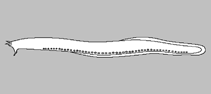
External aperture of its last efferent gill duct and pharyngocutaneous duct separated. Gill apertures nonlinear and crowded. Lengths of efferent gill ducts unequal with anterior ones much longer with length of first about 3 times that of last. Gill apertures 6. Slime pores: prebranchial 26; branchial 0; trunk 45; tail 9; total 80. Caudal and ventral finfold not well developed. Head, body, tail and finfold uniformly light brown in alcohol; eyespots faint, gill aperture margins not pale. Ventral aorta bifurcated between the fourth and fifth gill pouches (Ref. 41105).
Body shape (shape guide): eel-like.
Iteroparous (Ref. 94918).
Cycle de vie et comportement reproducteur
Maturité | Reproduction | Frai | Œufs | Fécondité | Larves
Iteroparous (Ref. 94918). Copulatory organ absent. The gonads of hagfishes are situated in the peritoneal cavity. The ovary is found in the anterior portion of the gonad, and the testis is found in the posterior part. The animal becomes female if the cranial part of the gonad develops or male if the caudal part undergoes differentiation. If none develops, then the animal becomes sterile. If both anterior and posterior parts develop, then the animal becomes a functional hermaphrodite. However, hermaphroditism being characterised as functional needs to be validated by more reproduction studies (Ref. 51361 ).
Mok, H.-K., L.M. Saavedra-Diaz and A.P. Acero, 2001. Two new species of Eptatretus and Quadratus (Myxinidae, Myxiniformes) from the Caribbean Coast of Colombia. Copeia 2001(4):1026-1033. (Ref. 41105)
Statut dans la liste rouge de l'IUCN (Ref. 130435: Version 2025-2 (Global))
Menace pour l'homme
Harmless
Utilisations par l'homme
Pêcheries: sans intérêt
Outils
Articles particuliers
Télécharger en XML
Sources Internet
Estimations basées sur des modèles
Indice de diversité phylogénétique (Réf.
82804): PD
50 = 0.5000 [Uniqueness, from 0.5 = low to 2.0 = high].
Bayesian length-weight: a=0.00204 (0.00094 - 0.00444), b=2.92 (2.72 - 3.12), in cm total length, based on LWR estimates for this (Sub)family-body shape (Ref.
93245).
Niveau trophique (Réf.
69278): 3.9 ±0.7 se; based on size and trophs of closest relatives
Résilience (Réf.
120179): Faible, temps minimum de doublement de population : 4,5 à 14 années (Fec assumed to be <100).
Vulnérabilité de la pêche (Ref.
59153): Low vulnerability (12 of 100).
🛈