>
Clupeiformes (Herrings) >
Engraulidae (Anchovies) > Coiliinae
Etymology: Thryssa: Greek, thrissa, -es = shad (Ref. 45335).
Eponymy: Jean-Jacques Dussumier (1792–1883) was a French merchant, collector, traveller and ship owner. [...] (Ref. 128868), visit book page.
More on author: Valenciennes.
Ambiente: milieu / zona climatica / distribuzione batimetrica / gamma di distribuzione
Ecologia
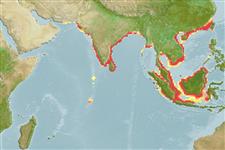
marino; salmastro pelagic-neritic; amfidromo (Ref. 51243); distribuzione batimetrica 0 - 50 m (Ref. 189). Tropical; 27°N - 7°S, 61°E - 121°E (Ref. 189)
Indo-Pacific: coasts of Pakistan, India, Myanmar and south of Penang; apparently not yet found in Gulf of Oman nor in the Persian Gulf; Malaysia, Indonesia north to Taiwan, no records from Papua New Guinea or northern coasts of Australia.
Dimensione / Peso / Età
Maturità: Lm ? range ? - ? cm
Max length : 11.0 cm SL maschio/sesso non determinato; (Ref. 189)
Spine dorsali (totale) : 0; Spine anali: 0; Raggi anali molli: 29 - 37. Belly with 21 to 24 keeled scutes from isthmus to anus. Maxilla very long, reaching at least halfway along pectoral fin and to pelvic fin base in adults; first supra-maxilla absent; lower jaw slender. gill rakers with serrae on the inner edge in distinct clumps. A dark blotch behind upper part of gill opening, sometimes joined to dark saddle on nape.
Body shape (shape guide): elongated; Cross section: compressed.
Coastal pelagic (Ref. 68964). Presumably schooling, mostly inshore and perhaps tolerating estuarine conditions. Feeds on diatoms when young and prawn larvae, copepods and cypris when larger. The number of museum specimens suggest that it is fairly common (but not in Bombay waters).
Ciclo vitale e comportamento di accoppiamento
Maturità | Riproduzione | Deposizione | Uova | Fecondità | Larve
Wongratana, T., T.A. Munroe and M. Nizinski, 1999. Order Clupeiformes. Engraulidae. Anchovies. p. 1698-1753. In K.E. Carpenter and V.H. Niem (eds.) FAO species identification guide for fishery purposes. The living marine resources of the WCP. Vol. 3. Batoid fishes, chimaeras and bony fishes part 1 (Elopidae to Linophrynidae). FAO, Rome. (Ref. 9822)
Stato della Lista Rossa IUCN (Ref. 130435: Version 2025-2 (Global))
Minaccia per l'uomo
Harmless
Usi umani
Pesca: commerciale
Strumenti
Rapporti speciali
Scarica XML
Fonti Internet
Stime basate su modelli
Temperatura preferita (Fonte Biblio.
123201): 25 - 29.2, mean 28.6 °C (based on 716 cells).
Indice di diversità filogenetica (Fonte Biblio.
82804): PD
50 = 0.5000 [Uniqueness, from 0.5 = low to 2.0 = high].
Bayesian length-weight: a=0.00575 (0.00324 - 0.01021), b=3.16 (3.01 - 3.31), in cm total length, based on LWR estimates for this species & Genus-body shape (Ref.
93245).
Livello trofico (Fonte Biblio.
69278): 2.8 ±0.21 se; based on food items.
Resilienza (Fonte Biblio.
120179): Alto, tempo minimo di raddoppiamento della popolazione meno di 15 mesi (Preliminary K or Fecundity.).
Vulnerabilità della pesca (Ref.
59153): Low vulnerability (10 of 100).
🛈