>
Cichliformes (Cichlids, convict blennies) >
Cichlidae (Cichlids) > Etroplinae
Etymology: Paretroplus: Name from the Greek 'para' meaning 'on the side of'; in taxonomy it is commonly used in generic names to express similarity or relatedness; in the present case it would mean 'next to Etroplus' (S.Kullander, pers.comm. 3/11); tsimoly: Tsimoly, pronounced in English as tsee-MOOL, is the name of this fish in the Sakalava dialect spoken by the people of the Akalimilotrabe region; it is to be treated as a noun in apposition (Ref. 78623).
محیط زیست: محیط زیست / منطقه آب و هوایی / تغييرات عمق / محدوده توزیع
بوم شناسي
; آب شيرين موجوداتی که در محدوده وسیعی از آبهای آزاد از نزدیک بستر و یا روی کف بستر، در قسمت های میان آبی تا سطح آب و در برخی گونه ها با قابلیت پرواز، زندگی و تغذیه می کنند.; تغييرات عمق 0 - 2 m (Ref. 40691). Tropical
Africa: Betsiboka River basin in Madagascar (Ref. 78623).
اندازه / وزن / سن
بلوغ: Lm ? range ? - ? cm
Max length : 25.0 cm SL جنس نر / بدون خواص جنسي; (Ref. 40691); 14.0 cm SL (female)
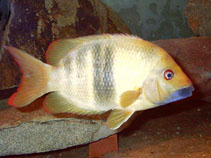
خارهاي باله پشتي (کل) : 15 - 17; شعاع نرم باله پشتي (کل) : 13 - 14; خارهاي باله مخرجي: 7 - 8; شعاع نرم باله مخرجي: 11 - 12; مهره ها: 31 - 32. Diagnosis: Paretroplus tsimoly is distinguished from all congerners in life and preservation by the possession of markedly enlarged, lobed bluish-gray to bluish-black (in life) or dark bluish-gray (in preservation) lips in adults; in addition, P. tsimoly, is distinguished from all congeners except P. lamenabe and P. nourissati by the presence of two wide, dark brown to black midlateral bands that converge below the lateral midline, representing the second and third, or third and fourth, bars in series (Ref. 78623). Paretroplus tsimoly is further distinguished from both P. lamenabe and P. nourissati by a lateral pigmentation pattern in which the posteriormost five, or four, as the bar on the caudal peduncle is sometimes pale, bars on the flank are about equally prominent, vs. only central two bars strongly pigmented and prominent in P. lamenabe and P. nourissati (Ref. 78623).
Body shape (shape guide): fusiform / normal; Cross section: compressed.
Found in flowing water with isolated pools; rocky bottom interspersed with patches of cobble and coarse gravel (Ref. 40691). A biparental substratum-spawner that practices long-term care of its fry; breeding pairs guarding fry (Ref. 40691). Stomach contents were mainly crushed insects, most of which appear to be nymphal odonates and hemipterans, and significant amounts of fibrous plant material (Ref. 40691).
چرخه زندگی و رفتار جفتگیری
بلوغ | تولید مثل | تخم ریزی | تخم ها | باروری | توزاد ( لارو)
Sparks, J.S., 2008. Phylogeny of the cichlid subfamily Etroplinae and taxonomic revision of the Malagasy cichlid genus Paretroplus (Teleostei: Cichlidae). Bull. Am. Mus. Nat. Hist. 314:1-151. (Ref. 78623)
وضعيت در فهرست قرمز IUCN (Ref. 130435: Version 2025-2 (Global))
خطر برای انسان ها
Harmless
استفاده انسانی
ابزارها
گزارش های ويژه
بارگيری XML
منابع اينترنتي
تخمینها بر اساس مدلها
شاخص تنوع فیلوژنتیکی (مرجع
82804): PD
50 = 0.5001 [Uniqueness, from 0.5 = low to 2.0 = high].
Bayesian length-weight: a=0.00389 (0.00180 - 0.00842), b=3.12 (2.94 - 3.30), in cm total length, based on all LWR estimates for this body shape (Ref.
93245).
سطح تروفیک (مرجع
69278): 2.8 ±0.32 se; based on food items.
جهندگی (مرجع
120179): متوسط, كمينه زمان لازم براي دو برابر شدن جمعيت 4/1 – 4/4 سال (Preliminary K or Fecundity.).
آسیبپذیری ماهیگیری (Ref.
59153): Low vulnerability (21 of 100).
🛈