Ambiente: milieu / zona climática / intervalo de profundidade / gama de distribuição
Ecologia
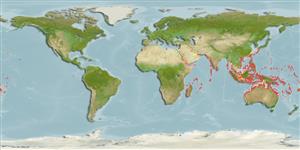
marinhas associadas(os) a recifes; não migratória (Ref. 52884); intervalo de profundidade 0 - 80 m (Ref. 9773). Tropical; 32°N - 34°S, 27°E - 170°W
Indo-Pacific: East Africa and eastward through northern Australia to Samoa; north to southern Japan. Replaced by closely related Sufflamen albicaudatus in the Red Sea (Ref. 37816).
Tamanho / Peso / Idade
Maturidade: Lm ? range ? - ? cm
Max length : 30.0 cm TL macho/indeterminado; (Ref. 30573)
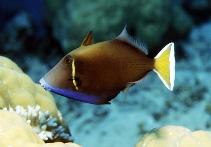
Espinhos dorsais (total) : 3; Raios dorsais moles (total) : 26 - 28; Espinhos anais: 0; Raios anais moles: 23 - 26. Juveniles dark brown above, white below (Ref. 1602). Adult variable in color; the bar running through the pectoral base can either be yellow or black, and some individuals may be largely yellowish posteriorly (Ref. 1602).
Body shape (shape guide): short and / or deep.
Adults inhabit coastal to outer reefs from silty lagoons to pristine outer reef walls (Ref. 48637). They occur in shallow lagoon and seaward reefs. Solitary and territorial. They feed on a wide variety of invertebrates. Also taken by drive-in nets (Ref. 9770). Oviparous (Ref. 205). Monogamous (Ref. 52884). Minimum depth reported taken from Ref. 128797.
Ciclo de vida e comportamento de acasalamento
Maturidade | Reprodução | Desova | Ovos | Fecundidade | Larvas
Male defends a defined territory, within which a female resides. On the day prior to spawning, female pushes her snout into the sandy bottom repeatedly and removes small stones and pieces of coral at several sites. Adhesive eggs are deposited on the sandy bottoms or in a small cavity of the reef covered with sand. Female fans the eggs and defends the nest, while male patrols around female (Ref. 8603). Females are territorial, solely tending and guarding the eggs (Ref. 116451). Males exhibit polygyny (Ref. 116451).
Myers, R.F., 1991. Micronesian reef fishes. Second Ed. Coral Graphics, Barrigada, Guam. 298 p. (Ref. 1602)
Categoria na Lista Vermelha da IUCN (Ref. 130435: Version 2025-2 (Global))
Ameaça para o homem
Harmless
Utilização humana
Pescarias: pouco comercial; Aquário: Espécies comerciais
Ferramentas
Relatórios especiais
Descarregue XML
Fontes da internet
Estimativas baseadas em modelos
Temperatura preferida (Ref.
123201): 24.8 - 29.3, mean 28.4 °C (based on 3050 cells).
Índice de diversidade filogenética (Ref.
82804): PD
50 = 0.5312 [Uniqueness, from 0.5 = low to 2.0 = high].
Bayesian length-weight: a=0.02455 (0.01594 - 0.03781), b=2.96 (2.83 - 3.09), in cm total length, based on LWR estimates for this species & (Sub)family-body (Ref.
93245).
Nível Trófico (Ref.
69278): 3.8 ±0.20 se; based on food items.
Resiliência (Ref.
120179): Médio, tempo mínimo de duplicação da população 1,4 - 4,4 anos (Preliminary K or Fecundity.).
Vulnerabilidade da pesca (Ref.
59153): Low vulnerability (20 of 100).
🛈
Nutrientes (Ref.
124155): Calcium = 46.6 [19.4, 116.8] mg/100g; Iron = 0.609 [0.306, 1.364] mg/100g; Protein = 18.5 [16.4, 20.6] %; Omega3 = 0.114 [0.058, 0.219] g/100g; Selenium = 30.6 [15.8, 63.6] μg/100g; VitaminA = 58.2 [17.0, 202.1] μg/100g; Zinc = 1.07 [0.72, 1.59] mg/100g (wet weight);