Taxonomic Remarks
Type locality: Bikini Atoll, Marshall Islands.
Milieu: milieu / Klimaatzone / Diepte / verspreidingsgebied
Ecologie
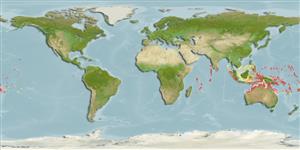
marien rifbewoner; diepte 0 - 30 m (Ref. 9710). Tropical; 12°N - 24°S, 55°E - 154°W (Ref. 5222)
Indo-West-Pacific: East coast of Africa to the Line Islands. Except for its occurrence along the African coast (Zanzibar, Tanzania to Ponta Zavora, Mozambique) it seems to be primarily an insular species, occurring at most (probably all) of the islands of tropical Indian and west-central Pacific. Not known from the Red Sea, Persian Gulf, Sri Lanka, Philippines, Taiwan, Japan, or Australian waters (however, it is found at Rowley Shoals off Western Australia).
Lengte bij maturiteit / Grootte / Gewicht / Leeftijd
Maturiteit: Lm ?, range 19 - ? cm
Max length : 47.5 cm TL mannelijk / geslacht onbekend; (Ref. 125599); max. gepubliceerd gewicht: 1.5 kg (Ref. 125599)
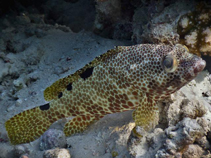
Dorsale stekels (totaal) : 11; Dorsale zachte stralen (totaal) : 14 - 16; Anale stekels: 3; Anale zachte stralen: 8. Preopercle rounded, with a shallow notch; the serrae are enlarged but covered with skin; upper edge of the operculum almost straight. The head and body mostly covered with close-set dark brown, olive, or reddish brown spots. Those on the dorsolateral parts of the head, body, and on median fins polygonal and close-set, with the interspaces forming a white reticulum. Those on the ventral portions are more rounded, more separated and often more reddish. Three dark blotches are often visible at the base of the dorsal fin and one forming a saddle blotch on the caudal peduncle. These blotches differentiates it from E. merra and E. quoyanus (Ref. 5222). Small conspicuous dark spots on snout and sometimes between or below the eyes (Ref. 37816).
Body shape (shape guide): fusiform / normal; Cross section: compressed.
Occurs in lagoon patch reefs, the upper slopes of channels, and reef margins (Ref. 1602). Carnivorous (Ref. 81697). Nothing has been published on its biology. Solitary (Ref 90102).
Levenscyclus en paargedrag
Maturiteit | Voortplanting | Paaien | Eieren | Fecunditeit | Larven
Heemstra, P.C. and J.E. Randall, 1993. FAO Species Catalogue. Vol. 16. Groupers of the world (family Serranidae, subfamily Epinephelinae). An annotated and illustrated catalogue of the grouper, rockcod, hind, coral grouper and lyretail species known to date. Rome: FAO. FAO Fish. Synop. 125(16):382 p. (Ref. 5222)
Status op de Rode Lijst van het IUCN (Ref. 130435: Version 2025-2 (Global))
Gevaar voor de mens
Harmless
Gebruik door de mens
Visserij: commercieel; sportvis: ja
Tools
Speciale rapporten
Download XML
Internetbronnen
Schattingen op basis van modellen
Gewenste temperatuur (Ref.
123201): 26.1 - 29.3, mean 28.6 °C (based on 1392 cells).
Fylogenetische diversiteitsindex (Ref.
82804): PD
50 = 0.5000 [Uniqueness, from 0.5 = low to 2.0 = high].
Bayesian length-weight: a=0.01096 (0.00686 - 0.01753), b=3.06 (2.93 - 3.19), in cm total length, based on LWR estimates for this species & Genus-body shape (Ref.
93245).
Trofisch niveau (Ref.
69278): 3.8 ±0.6 se; based on size and trophs of closest relatives
Weerstandsvermogen (Ref.
120179): Gemiddeld, minimale populatieverdubbelingstijd 1,4-4,4 jaar (Preliminary K or Fecundity.).
Kwetsbaarheid van de visserij (Ref.
59153): Moderate vulnerability (38 of 100).
🛈
Voedingsstoffen (Ref.
124155): Calcium = 37.5 [18.0, 76.4] mg/100g; Iron = 0.528 [0.290, 1.094] mg/100g; Protein = 18.5 [17.0, 19.9] %; Omega3 = 0.123 [0.077, 0.196] g/100g; Selenium = 27.3 [16.0, 48.5] μg/100g; VitaminA = 228 [63, 825] μg/100g; Zinc = 1.45 [0.99, 2.03] mg/100g (wet weight); based on
nutrient studies.