Classification / Noms
Noms communs | Synonymes | Catalog of Fishes(Genre, Espèce) | ITIS | CoL | WoRMS | Cloffa
>
Siluriformes (Catfishes) >
Loricariidae (Armored catfishes) > Loricariinae
Eponymy: Charles Frederick Hartt (1840–1878) was a Canadian geologist, palaeontologist and naturalist, who was a member of the Thayer Expedition (1865–1866) to Brazil, a country in which he was a specialist. [...] (Ref. 128868), visit book page.
Environnement : milieu / zone climatique / profondeur / gamme de distribution
Écologie
; eau douce démersal. Tropical
South America: Uatumã River basin, Brazil.
Taille / Poids / Âge
Maturité: Lm ? range ? - ? cm
Max length : 12.6 cm SL mâle / non sexé; (Ref. 39753)
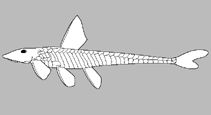
Head and predorsal are marbled of dark and light brown; the rest of the dorsal surface yellowish with 3-4 faded transverse brown bars after dorsal fin. Ventral surface brown on snout and upper lip and the rest of the body uncolored. Dorsal fin inconspicuously spotted with a black blotch at tip of first rays. Pectoral and pelvic fin yellowish, with faded spots distally. Depressed head and body; head depth 2.8-3.2 times in HL; body depth 3-3.7 times in HL. Belly totally naked from throat to pelvic fins. In sexually mature males, no strongly curved pectoral spine; flat, broad spine, tapering towards the tip, covered by large odontodes on 2/3 of its length. Rictal barbel reduced and attached to lower lip by small membrane. Large subpreopercle strongly triangular with mesial side curved, plate boomerang shaped (Ref. 40703).
Body shape (shape guide): elongated.
Cycle de vie et comportement reproducteur
Maturité | Reproduction | Frai | Œufs | Fécondité | Larves
Rapp Py-Daniel, L.H. and E.C. Oliveira, 2001. Seven new species of Harttia from the Amazonian-Guyana region (Siluriformes: Loricariidae). Ichthyol. Explor. Freshwat. 12(1):79-96. (Ref. 39753)
Statut dans la liste rouge de l'IUCN (Ref. 130435: Version 2025-2 (Global))
Menacé (EN) (B1ab(i,iii,iv)); Date assessed: 07 November 2018
Menace pour l'homme
Harmless
Utilisations par l'homme
Outils
Articles particuliers
Télécharger en XML
Sources Internet
Estimations basées sur des modèles
Indice de diversité phylogénétique (Réf.
82804): PD
50 = 0.5000 [Uniqueness, from 0.5 = low to 2.0 = high].
Bayesian length-weight: a=0.00589 (0.00267 - 0.01297), b=3.07 (2.90 - 3.24), in cm total length, based on LWR estimates for this Genus-body shape (Ref.
93245).
Niveau trophique (Réf.
69278): 2.5 ±0.2 se; based on size and trophs of closest relatives
Résilience (Réf.
120179): Milieu, temps minimum de doublement de population : 1,4 à 4,4 années (Preliminary K or Fecundity.).
Vulnérabilité de la pêche (Ref.
59153): Low vulnerability (10 of 100).
🛈