>
Lophiiformes (Anglerfishes) >
Oneirodidae (Dreamers)
Etymology: Oneirodes: Greek, 'oneiros' = a dream or dreamlike or out of a dream (suggesting this fish is so strange and marvelous that can exist only in dreams) (Ref. 86949); alius: The name alius is an adjective in apposition from the Latin, meaning another, alluding to the seemingly never-ending number of new forms being discovered within the genus.
Environnement : milieu / zone climatique / profondeur / gamme de distribution
Écologie
marin bathypélagique; profondeur 575 - 1200 m (Ref. 39614). Deep-water
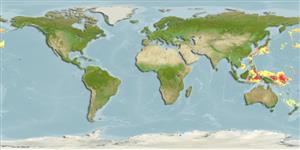
Indo-West Pacific: only from Halmahera Sea.
Taille / Poids / Âge
Maturité: Lm ? range ? - ? cm
Max length : 3.8 cm SL mâle / non sexé; (Ref. 39614)
Description synthétique
Clés d'identification | Morphologie | Morphométrie
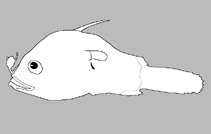
Rayons mous dorsaux (Total) : 5 - 7; Rayons mous anaux: 4. Characterized by having escal morphology: esca with single elongate tapering anterior appendage, 33.3-43.0% SL, without internal pigment; pair of filamentous medial appendages; rounded terminal escal papilla with two bilaterally placed distal pigment spots; short, unpigmented, anteroposteriorly compressed posterior escal appendage; lateral and anterolateral escal appendages absent; large, elongate subopercle with dorsal end tapering to a point, without indentation on posterodorsal margin; length of ventral fork of opercle 30.3-32.3% SL; ratio of lengths of the dorsal and ventral forks of opercle 0.44-0.52; absence of epibranchial teeth; presence of teeth on pharyngobranchial II; upper jaw teeth 28-32, lower jaw teeth 33-37; teeth on vomer 6; dorsal fin rays 5-7; anal fin rays 4; pectoral fin rays 15-16; head length 50.0% SL; head depth 43.0-48.5% SL; premaxilla length 38.0% SL; length of lower jaw 47.5% SL; length of illicium 26.5-35.5% SL (Ref. 86949).
Body shape (shape guide): short and / or deep.
Cycle de vie et comportement reproducteur
Maturité | Reproduction | Frai | Œufs | Fécondité | Larves
Seigel, J.A. and T.W. Pietsch, 1978. A new species of the ceratioid anglerfish genus Oneirodes (Pisces: Lophiiformes) from the Indo-west Pacific. Copeia 1978(1):11-13. (Ref. 39614)
Statut dans la liste rouge de l'IUCN (Ref. 130435: Version 2025-2 (Global))
Menace pour l'homme
Harmless
Utilisations par l'homme
Outils
Articles particuliers
Télécharger en XML
Sources Internet
Estimations basées sur des modèles
Température préférée (Réf.
123201): 5.5 - 7.2, mean 6.2 °C (based on 38 cells).
Indice de diversité phylogénétique (Réf.
82804): PD
50 = 0.5000 [Uniqueness, from 0.5 = low to 2.0 = high].
Bayesian length-weight: a=0.01995 (0.00906 - 0.04395), b=3.01 (2.83 - 3.19), in cm total length, based on all LWR estimates for this body shape (Ref.
93245).
Niveau trophique (Réf.
69278): 3.4 ±0.6 se; based on size and trophs of closest relatives
Résilience (Réf.
120179): Haut, temps minimum de doublement de population inférieur à 15 mois (Preliminary K or Fecundity.).
Vulnérabilité de la pêche (Ref.
59153): Low vulnerability (10 of 100).
🛈