Élasmobranches (requins et raies) (sharks and rays) >
Carcharhiniformes (Ground sharks) >
Pentanchidae (Deepwater catsharks)
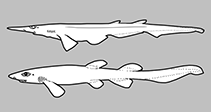
Etymology: Apristurus: a-, Latin privative, i.e., without; pristis, from pristes (Gr.), sawyer (but here meaning saw); oura (Gr.), tail, referring to absence of saw-toothed crest of enlarged dermal denticles along upper edge of caudal fin as found in the closely related Pristiurus (=Galeus) (See ETYFish); fedorovi: In honor of ichthyologist Vladimir Vladimirovich Fedorov (1939-2011), Zoological Institute, Russian Academy of Sciences (Saint Petersburg), the first to collect this shark (See ETYFish).
Eponymy: Dr Vladimir Vladimirovich Fedorov (1939–2011) was a Russian ichthyologist. [...] (Ref. 128868), visit book page.
Environnement : milieu / zone climatique / profondeur / gamme de distribution
Écologie
marin bathypélagique; profondeur 100 - 1500 m (Ref. 50610). Deep-water
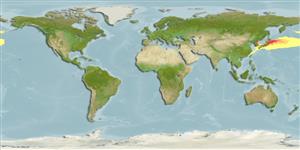
Northwest Pacific: Tohoku Slope, Japan.
Taille / Poids / Âge
Maturité: Lm ? range ? - ? cm
Max length : 68.3 cm TL mâle / non sexé; (Ref. 39431)
Cycle de vie et comportement reproducteur
Maturité | Reproduction | Frai | Œufs | Fécondité | Larves
Oviparous, paired eggs are laid. Embryos feed solely on yolk (Ref. 50449).
Nakaya, K. and B. Séret, 1999. A new species of deepwater catshark, Apristurus albisoma n.sp. from New Caledonia (Chondrichthyes: Carcharhiniformes: Scyliorhinidae). Cybium 23(3):297-310. (Ref. 36058)
Statut dans la liste rouge de l'IUCN (Ref. 130435: Version 2025-2 (Global))
Menace pour l'homme
Harmless
Utilisations par l'homme
Outils
Articles particuliers
Télécharger en XML
Sources Internet
Estimations basées sur des modèles
Température préférée (Réf.
123201): 0.4 - 4, mean 1.8 °C (based on 25 cells).
Indice de diversité phylogénétique (Réf.
82804): PD
50 = 0.5000 [Uniqueness, from 0.5 = low to 2.0 = high].
Bayesian length-weight: a=0.00347 (0.00172 - 0.00698), b=3.08 (2.90 - 3.26), in cm total length, based on LWR estimates for this (Sub)family-body shape (Ref.
93245).
Niveau trophique (Réf.
69278): 4.0 ±0.6 se; based on size and trophs of closest relatives
Résilience (Réf.
120179): Très faible, temps minimum de doublement de population supérieur à 14 ans (Fec assumed to be <10).
Vulnérabilité de la pêche (Ref.
59153): Moderate to high vulnerability (47 of 100).
🛈