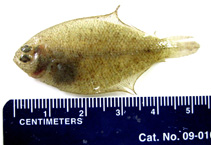
Umwelt: Milieu / Klimazone / Tiefenbereich / Verbreitungsgebiet
Ökologie
seewasser demersal; tiefenbereich ? - 31 m (Ref. 58018). Temperate
Western Central Atlantic: north of Cape Hatteras, North Carolina, to about Palm Beach on east coast of Florida and in Gulf of Mexico from Fort Myers, Florida, to Mississippi; apparently rare or absent in southern Florida.
Größe / Gewicht / Alter
Geschlechtsreife: Lm ? range ? - ? cm
Max length : 9.0 cm SL Männchen/unbestimmt; (Ref. 39355)
Rückenflossenweichstrahlen (insgesamt) : 70 - 82; Afterflossenweichstrahlen: 54 - 64.
Body shape (shape guide): other (see remarks).
Lebenszyklus und Paarungsverhalten
Geschlechtsreife | Fortpflanzung | Ablaichen | Eier | Fruchtbarkeit | Larven
Distinct pairing (Ref. 205).
Leslie, A.J. Jr. and D.J. Stewart, 1986. Systematics and distributional ecology of Etropus (Pisces, Bothidae) on the Atlantic Coast of the United States with description of a new species. Copeia 1986(1):140-156. (Ref. 39355)
IUCN Rote Liste Status (Ref. 130435: Version 2025-2 (Global))
Bedrohung für Menschen
Harmless
Nutzung durch Menschen
Tools
Zusatzinformationen
Download XML
Internet Quellen
Schätzungen auf der Grundlage von Modellen
Phylogenetischer Diversitätsindex (Ref.
82804): PD
50 = 0.5010 [Uniqueness, from 0.5 = low to 2.0 = high].
Bayesian length-weight: a=0.00891 (0.00396 - 0.02008), b=3.02 (2.82 - 3.22), in cm total length, based on LWR estimates for this (Sub)family-body shape (Ref.
93245).
Trophische Ebene (Ref.
69278): 3.4 ±0.2 se; based on size and trophs of closest relatives
Widerstandsfähigkeit (Ref.
120179): hoch, Verdopplung der Population dauert weniger als 15 Monate. (Preliminary K or Fecundity.).
Anfälligkeit der Fischerei (Ref.
59153): Low vulnerability (10 of 100).
🛈