>
Perciformes/Scorpaenoidei (Scorpionfishes) >
Scorpaenidae (Scorpionfishes or rockfishes) > Scorpaeninae
Etymology: Sebastapistes: Greek, sebastes = august, venerable + Greek apistia, -as = distrust (Ref. 45335).
Eponymy: Henry Weed Fowler (1878–1965) was an American herpetologist, ornithologist, ichthyologist and artist. [...] (Ref. 128868), visit book page.
Umwelt: Milieu / Klimazone / Tiefenbereich / Verbreitungsgebiet
Ökologie
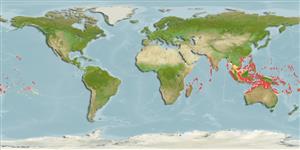
seewasser riff-verbunden; tiefenbereich 2 - 61 m (Ref. 48236). Tropical; 23°N - 24°S
Indo-Pacific: Mauritius and the Comoro Islands to Pitcairn, north to the Hawaiian Islands.
Größe / Gewicht / Alter
Geschlechtsreife: Lm ? range ? - 2.4 cm
Max length : 4.7 cm TL Männchen/unbestimmt; (Ref. 90102)
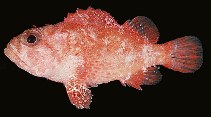
Rückenflossenstacheln (insgesamt) : 12; Rückenflossenweichstrahlen (insgesamt) : 9; Afterflossenstacheln: 3; Afterflossenweichstrahlen: 5. Eye not extending above the dorsal profile of the head. Large pores of the cephalic lateralis system, nasal pore above and adjacent to posterior nostril with a very small retrorse nasal spine (may be absent) on its upper edge. Low ridge like spines dorsally on the head. Preocular spine embedded; sphenotic spines absent or embedded; and postorbital spines absent. Posterior lacrimal spine projecting slightly anteriorly, and a single spine posteriorly on the suborbital ridge with a pore-associated spine just below the ridge under the posterior third of the eye (Ref. 48236).
Body shape (shape guide): fusiform / normal; Cross section: oval.
Found in areas with rubble or mixed sand and rubble, within or near coral reefs (Ref. 48236, 58302). Benthic (Ref. 58302). Feeds on small fishes (Ref. 89972). Venomous spines (Ref. 1602). Solitary (Ref 90102).
Lebenszyklus und Paarungsverhalten
Geschlechtsreife | Fortpflanzung | Ablaichen | Eier | Fruchtbarkeit | Larven
Randall, J.E. and S.G. Poss, 2002. Redescription of the Indo-Pacific scorpionfish Scorpaenopsis fowleri and reallocation to the genus Sebastapistes. Pac. Sci. 56(1):57-64. (Ref. 48236)
IUCN Rote Liste Status (Ref. 130435: Version 2025-2 (Global))
Nutzung durch Menschen
Tools
Zusatzinformationen
Download XML
Internet Quellen
Schätzungen auf der Grundlage von Modellen
Bevorzugte Temperatur (Ref.
123201): 25.4 - 28.9, mean 27.6 °C (based on 494 cells).
Phylogenetischer Diversitätsindex (Ref.
82804): PD
50 = 0.5002 [Uniqueness, from 0.5 = low to 2.0 = high].
Bayesian length-weight: a=0.01288 (0.00626 - 0.02652), b=3.02 (2.85 - 3.19), in cm total length, based on LWR estimates for this (Sub)family-body shape (Ref.
93245).
Trophische Ebene (Ref.
69278): 3.4 ±0.6 se; based on size and trophs of closest relatives
Widerstandsfähigkeit (Ref.
120179): hoch, Verdopplung der Population dauert weniger als 15 Monate. (Preliminary K or Fecundity.).
Anfälligkeit der Fischerei (Ref.
59153): Low vulnerability (10 of 100).
🛈
Nährstoffe (Ref.
124155): Calcium = 187 [87, 471] mg/100g; Iron = 1.03 [0.48, 2.53] mg/100g; Protein = 18 [16, 20] %; Omega3 = 0.299 [0.116, 0.868] g/100g; Selenium = 24.4 [10.2, 63.8] μg/100g; VitaminA = 213 [67, 667] μg/100g; Zinc = 2.18 [1.37, 3.31] mg/100g (wet weight);