Umwelt: Milieu / Klimazone / Tiefenbereich / Verbreitungsgebiet
Ökologie
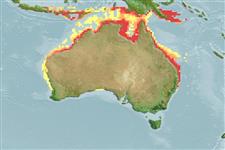
seewasser; brackwasser pelagic-neritic; tiefenbereich 0 - 50 m (Ref. 189). Tropical; 7°S - 32°S, 112°E - 156°E (Ref. 189)
Western Pacific: Australia (northern coasts from Onslow east to Gulf of Carpentaria; and eastern coasts from Brisbane south to 30°S, but presumably to the north also) and Papua New Guinea.
Größe / Gewicht / Alter
Geschlechtsreife: Lm ? range ? - ? cm
Max length : 13.8 cm SL Männchen/unbestimmt; (Ref. 189)
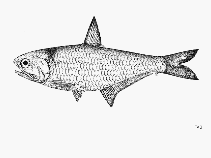
Rückenflossenstacheln (insgesamt) : 0; Afterflossenstacheln: 0; Afterflossenweichstrahlen: 30 - 34. Belly with 14 to 16 + 8 or 9 = 22 to 25 keeled scutes from isthmus to anus. Maxilla short, reaching to hind border of pre-operculum; first supra-maxilla short, about half length of second. Pseudobranch very short. A diffuse saddle on nape; no dark blotch behind gill opening.
Body shape (shape guide): fusiform / normal; Cross section: compressed.
Presumed marine, pelagic, coastal, but also estuarine, thus tolerating lowered salinities. More data needed.
Lebenszyklus und Paarungsverhalten
Geschlechtsreife | Fortpflanzung | Ablaichen | Eier | Fruchtbarkeit | Larven
Wongratana, T., T.A. Munroe and M. Nizinski, 1999. Order Clupeiformes. Engraulidae. Anchovies. p. 1698-1753. In K.E. Carpenter and V.H. Niem (eds.) FAO species identification guide for fishery purposes. The living marine resources of the WCP. Vol. 3. Batoid fishes, chimaeras and bony fishes part 1 (Elopidae to Linophrynidae). FAO, Rome. (Ref. 9822)
IUCN Rote Liste Status (Ref. 130435: Version 2025-2 (Global))
Bedrohung für Menschen
Harmless
Nutzung durch Menschen
Tools
Zusatzinformationen
Download XML
Internet Quellen
Schätzungen auf der Grundlage von Modellen
Bevorzugte Temperatur (Ref.
123201): 24.2 - 28.7, mean 27.5 °C (based on 406 cells).
Phylogenetischer Diversitätsindex (Ref.
82804): PD
50 = 0.5000 [Uniqueness, from 0.5 = low to 2.0 = high].
Bayesian length-weight: a=0.00708 (0.00307 - 0.01632), b=3.05 (2.86 - 3.24), in cm total length, based on LWR estimates for this (Sub)family-body shape (Ref.
93245).
Trophische Ebene (Ref.
69278): 3.4 ±0.5 se; based on size and trophs of closest relatives
Widerstandsfähigkeit (Ref.
120179): hoch, Verdopplung der Population dauert weniger als 15 Monate. (k=1.56).
Anfälligkeit der Fischerei (Ref.
59153): Low vulnerability (10 of 100).
🛈