Classificatie / Namen
Lokale namen | Synoniemen | Catalog of Fishes(Genus, Soort(en)) | ITIS | CoL | WoRMS | Cloffa
>
Siluriformes (Catfishes) >
Sisoridae (Sisorid catfishes) > Glyptosterninae
Etymology: Oreoglanis: Greek, oreos = mountain+Greek, glanis = Latin, aurum = gold + Greek, glanis = a fish that can eat the bait without touching the hook; a cat fish (Ref. 45335); hypsiura: Specific name from the Greek hypos which means high, and oura which means tail, in reference to the relatively deeper caudal peduncle compared to O. delacouri.
More on authors: Ng & Kottelat.
Milieu: milieu / Klimaatzone / Diepte / verspreidingsgebied
Ecologie
; zoet water benthopelagisch. Tropical
Asia: Mekong basin in Laos.
Grootte / Gewicht / Leeftijd
Maturiteit: Lm ? range ? - ? cm
Max length : 13.8 cm SL mannelijk / geslacht onbekend; (Ref. 43281)
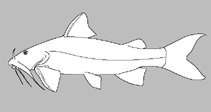
Dorsale stekels (totaal) : 0; Dorsale zachte stralen (totaal) : 7; Anale zachte stralen: 4 - 5; Wervels: 40 - 42. Can be differentiated from its congeners in having a unique combination of the following characters: lower lip lacking a median notch and having a posterior margin with lobulate projections, lunate caudal fin with elongate, strap-like lower principal ray in mature males, gill slit arched, nasal barbel reaching about half of the distance to the eye, presence of a pale elliptical patch on sides of body below adipose fin, male genital papilla located immediately behind the anus in a depression terminating posteriorly with a straight transverse wall, caudal peduncle 6.1-7.1 times longer than deep, length of caudal peduncle 18.7-21.7% SL, depth of caudal peduncle 2.7-3.6% SL, post-adipose distance 8.6-11.6% SL, snout length 57.9-61.2% HL, eye diameter 8.6-10.0% HL, interorbital distance 23.7-27.2% HL and maxillary barbel with rounded tip (Ref. 37793); lower caudal lobe with a long ribbon-like extension in male (Ref. 43281).
Body shape (shape guide): elongated; Cross section: flattened.
Levenscyclus en paargedrag
Maturiteit | Voortplanting | Paaien | Eieren | Fecunditeit | Larven
Ng, H.H. and W.J. Rainboth, 2001. A review of the sisorid catfish genus Oreoglanis (Siluriformes: Sisoridae) with descriptions of four new species. Occas. Pap. Mus. Zool. Univ. Mich. (732):1-34. (Ref. 44353)
Status op de Rode Lijst van het IUCN (Ref. 130435: Version 2025-2 (Global))
Gevaar voor de mens
Harmless
Gebruik door de mens
Tools
Speciale rapporten
Download XML
Internetbronnen
Schattingen op basis van modellen
Fylogenetische diversiteitsindex (Ref.
82804): PD
50 = 0.5000 [Uniqueness, from 0.5 = low to 2.0 = high].
Bayesian length-weight: a=0.00603 (0.00269 - 0.01352), b=3.08 (2.88 - 3.28), in cm total length, based on LWR estimates for this (Sub)family-body shape (Ref.
93245).
Trofisch niveau (Ref.
69278): 3.2 ±0.4 se; based on size and trophs of closest relatives
Weerstandsvermogen (Ref.
120179): Gemiddeld, minimale populatieverdubbelingstijd 1,4-4,4 jaar (Preliminary K or Fecundity.).
Kwetsbaarheid van de visserij (Ref.
59153): Low vulnerability (10 of 100).
🛈